| Tagline: | international media arts festival berlin |
|---|---|
| Venues: | Podewil, Maria am Ostbahnhof |
| Date: | 11.02 – 22.02.1999 |
| Organisation: | Berliner Kulturveranstaltungs-GmbH |
| Website: | https://pastwebsites.transmediale.de/99/ |
With a new byline ‘international media arts festival berlin‘, transmediale '99 invited artists, scientists and commercial producers to present digital worlds and beings in films, video, and games. It acknowledged the entertainment industry and its stimulating experiments with art, design and modern technologies, as well as the revolutionary changes the branch has undergone and brought about. The '99 festival also saw the introduction of club transmediale.
festival catalogue preface
The annual challenge of re-inventing the festival was one happily taken up by the 1999 transmediale team. The festival, not unlike the swiftly changing field of new media, remains subject to that process of constant change which over the past 12 years fuelled its evolution from VideoFest to transmediale. The new byline ‘international media art festival berlin' signals the determination of this established event in the German capital to remain alert to future developments, regardless of place of origin, and open for diverse expressive means.
As the new millennium approaches, the transmediale takes another step forward with a new forum underscoring our belief in the relevance of the entertainment industry and its stimulating experiments with art, design and modern technologies, as well as the revolutionary changes the branch has undergone and brought about.
In the framework of various events distributed over several days, artists, scientists and commercial producers will have the opportunity to present digital worlds and beings in film, video and games. The transmediale, keen to stay at the cutting edge and less encumbered with ballast than the Berlinale, is able to respond more quickly to emergent media trends and in this way complement the popular film festival which runs concurrently.
Last year's decision to engage guest curators for specialist areas further heightened the topicality and expertise on offer at the transmediale. Adhering to this concept, we were fortunate enough to recruit guest curators whose diverse origins and specialities can only enrich the transmediale.
The core of the festival, and guarantee for up-to-the-minute productions and advanced concepts, continues to be the competition for video, computer animation, CD-ROM, Internet, television, and installation art. In view of the importance media academies now attach to digital production techniques, it seemed logical to change the rules of the student competition, which was formerly restricted to video, and invite the submission of work in any of the media addressed by the festival. This decision was rewarded by a comparably high number of entries.
With a new format and concept, this catalogue is a further innovation. Formerly a brochure dedicated to the day-by-day programme, its scope has been widened to include general information and texts on media theory which will remain relevant after the festival closes. The rear section of the catalogue offers profiles of the exhibits, performances and videos, making for greater clarity and again inviting subsequent reference.
The catalogue structure reflects the two mainstays of the programme: the afternoon ‘presentations' curated by experts and dedicated to innovative and stimulating media projects. These are followed in the evening by ‘screenings' featuring video productions and computer animations chosen for their entertainment value and artistic ambition, and inviting audiences to sit back and let the visuals do the rest.
Video – a medium some would already term 'classical' – appears to have taken on a new lease of life recently, despite the rapid advancements in other, even younger media. The transmediale, whose festival career began under the title VideoFest, is honour-bound to explore these developments, and place a spotlight on young video artists as well as a number of re-discoveries.
Further evidence that video did not come to a standstill in the 1980s but has remained an artistic force in the ‘90s (and seems likely to do so in the foreseeable future) is provided by the 'club transmediale'. The transmediale's first-ever satellite outside the Podewil will act as venue for artists' video in a club/lounge setting: daily experimentation and DJ/VJ sets, in collaboration with transmediale artists as a work-in-progress.
In future, we plan to expand such cooperation – either side stands to benefit from the reciprocal inspiration, and can work together in producing a festival in Berlin that is distinctive – re-invented – year for year.
Micky Kwella & Susanne Jaschko, Curators
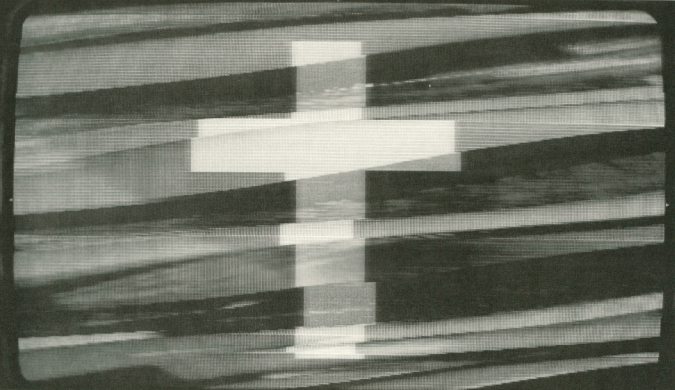
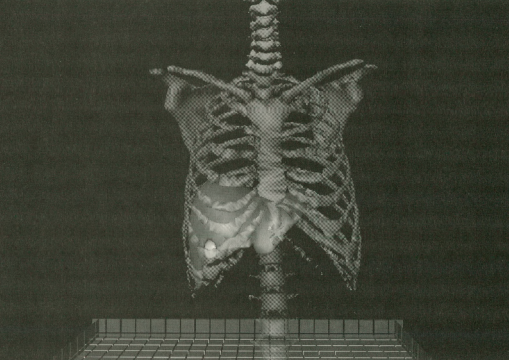
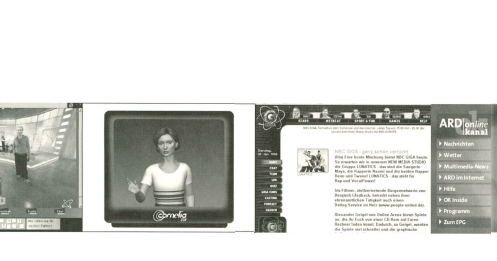
The programme of transmediale '99 reflects the new models of media experimentation seen: a broadened transmediale award, no longer restricted to just video entries, a new catalogue, organised to include general information and texts on media theory, followed by profiles on the festival exhibitions, performances, and videos. This reflects the mainstays of the programme: the afternoon presentations curated by experts and dedicated to innovative and stimulating media projects, followed in the evening by screenings featuring video productions and computer animations chosen for their entertainment value and artistic ambition, and inviting audiences to sit back and let the visuals do the rest. This year also welcomes the introduction of club transmediale. The transmediale's first-ever satellite outside the Podewil will act as venue for artists' video in a club/lounge setting: daily experimentation and DJ/VJ sets, in collaboration with transmediale artists as a work-in-progress.
transmediale award
First Prize in the category Video goes to Take Me Home by Matt Hulse, for its eccentric grainy naked digital dirtyness, Second Prize in the category Video goes to Zoetrope by Joseph Hyde, for its virtuoso audiovisual score and for building a rich visual world from nothing more than a few dropouts. The Prize in the category CD-ROM goes to Nightwalks by Hugo Glendinning and Tim Etchells, with Forced Entertainment for truly seamless use of Quicktime VR and its stunning photography and unobstrusive use of technology. The Prize in the category Internet goes to The Future Looms – Holes Lining Threads by Alicia Felberbaum for its cleverly woven adaptation of computer history based on the industrial revolution and specifically the textile industry.
transmediale student award
Aus den Sterntagebüchern des Ijon Tichy by Oliver Jahn, Dennis Jacobson, and Randa Chahoud, and Shit Kid Tales by Nico Ihlein are the winners of the transmediale student Video award, MUT DER AHNUNGSLOSEN by Rigoletti M. und Lotio F. won for the CD-ROM award.
Formerly a brochure dedicated to the day-by-day programme, the transmediale '99 catalogue's scope has been widened to include general information and texts on media theory which will remain relevant after the festival closes, in addition to the usual profiles of the exhibits, performances, and videos.
team
Micky Kwella Direction, Dr. Christoph Metzger Management, Micky Kwella, Susanne Jaschko Curators, Karin Schyle Curatorial Assistant, Axel Bohse Media Art Installations, Micky Kwella, Susanne Jaschko, Dr. Thomas Beutelschmidt, Tom Sperlich, Tilman Baumgärtel, Henry Steinhau, Herbert Gehr, Stephan Ott, im stall, Dr. Wolf Siegert, Uli Weinberg, Danny Yung, Oke Maas, Rudolf Frieling Program,
Micky Kwella, Susanne Jaschko, Safy (Assaf Etiel) Compilation Video, Micky Kwella, Susanne Jaschko, Timm Ringewaldt, Tilman Baumgärtel, Compilation Internet Projects, Micky Kwella, Susanne Jaschko, Timm Ringewaldt Compilation CD-ROMS, Sonja Bender, Timm Ringewaldt, Eliane Schott, Alexander Sellschopp, Carsten Stabenow, Annabelle Wiek Student Works, Christine Sievers Press, Birgit Papaschek Press Assistant, Angelika Wieland, Christina Kempe Organization, Karin Schyle, Boris Schmidt, Amie Robinson Organization Assistants, Dr. Christoph Metzger, Flora Tálasi Sponsoring, Maximilian Stelzl Technical Support Podewil, Matthias Behrens Technical Support transmediale, Hannes Ickert Technical Support Assistant transmediale, Prof. Stefan Koppelkamm's Group (Kunsthochschule Berlin-Weißensee) Exhibition Design, Stefaan Decostere, Anne-Marie Duguet, John Hanhardt, Wulf Herzogenrath, Joachim Sauter Advisory Board
supporters
Sponsors: Apple, Berliner Kulturberanstaltung-Gesellschaft mbH, Botschaft von Frankreich, Europäische Kommission, Hauptstadtkulturfonds, Podewil, Senatsverwaltung für Wissenschaft, Forschung und Kultur Berlin, PandaSoft, av.f medienprojekte gmbh, GATE, die tageszeitung, Institut Français Berlin, PIK, The British Council, Contrib.Net, Volkswagen Art & Shuttle, TNT, RadioEins, Art + Com, B1. Das Belrin-Fernsehen vom SFB.
Media Partners: B l. Das Berlin - Fernsehen vom SFB, die tageszeitung, RadioEINS