Podewil
11 – 20 February 2000
Presenting five media art installations and twenty-five net.art projects and CD-ROMs, the transmediale 2000 exhibition brought together the previously divided categories of CD-ROM and Internet art at a time when the lines between the two started to dissolve.
Visitors could explore video installations by e.g. French artists Robert Cahen with Tombe or Hermen Maat from the Netherlands, with his Paranoid Panopticum. The other part of the exhibition displayed various internet art projects, which dealt with experimental software topics, such as the Linker by the British art group Mongrel or the game SOD o.1, redesigned by Barcelona based art duo JODI. Other artists were investigating and visualising hidden communications structures like Lisa Jevbratt with 1:1 or were giving us the opportunity to wander within virtual sound installations like the on-line project www.electrica.de .
Media Art Installations
Having just crossed a magical threshold, we look forward with excitement to what the new millennium holds in store. Nobody knows what philosophical trends, political influences, social upheavals and catastrophes lie in wait for us. Only one thing seems to be clear. More than ever before the period ahead will be one of technological superlatives and a media explosion. The latest developments from the research laboratories and high-tech forges will be linked with all sorts of fields and functions at an ever greater speed and open up new opportunities for survival. At the same time, the detachment of physical and intellectual existence will become more and more tangible in boundless creative scenarios. At this customary and yet remarkable point in time, art - and perhaps media art, in particular – needs to be held up as a mirror. The installations that have been selected represent a cross-section of current artistic positions ranging from a new stress on content via materiality to the technically feasible.
Scott Sona Snibbe’s interactive installation, Boundary Functions, appears almost like a party game. Although this system of fragile lines of light actually represents a group-dynamic phenomenon, it is the individual interplay of convergence and dissociation which is at the heart of the interaction. Herman Maat’s interactive installation, The Paranoid Panopticum, takes up the ancient Greek story of Narcissus and looks at what reflections tell us. Saorise Higgins and Ian Gwilt were presumably inspired by New Zealand’s endless beaches to construct shapes and signs fleetingly etched in the sand as bridges between reality and imagination. Their interactive installation, Streaming, lends a new quality to one of the oldest storage media in the world. Prehistoric rocks in various shapes and sizes provide Yeoh Guan Hong and Yulius with the point of departure for their interactive installation, The H.E.A.R.T. of Stone. They literally link the weight of this world with associative sounds and pictures. Robert Cahen is one of the best-known European video artists. Using the pictorial language for which he is famous, Cahen has produced his first series of video installations, from which the work Tombe is taken.
Axel Bohse, Curator
slim volumes of prose with hit potential: CD-ROM / Internet
Obviously, one could simply show the best commercial Website of 1999. It is certainly true that a gratifying number of commercial Internet presentations are doing increasing justice to the medium they appear in, due to the fact that the multimedia agencies responsible for them have drawn up, in the course of several years of orientation, important ‘do’s’ and ‘don’ts’ that the branch complies with.
Yet beyond the obligation to observe the market situation on the Internet and the indubitably ever-more professional and appealing corporate presentations, the task of an institution like the transmediale is to search for Internet projects that are unusual, combine initiative with media skills, are more art-oriented than business-focused. It is a question of bringing these projects to the surface, of drawing attention to the URLs that otherwise remain invisible and unvisited in the universe of the WWW.
(Too) often still, these in all events non-commercial (is ‘artistic’ still really the apt term?) projects are reminiscent of slim volumes of prose bookstores place alongside bestsellers like 1,000 Ways to Save Tax or the latest Stephen King thriller. Every-body appreciates their existence, but the utility or addiction factor is well-nigh zero, and hardly anybody is willing to spare their time or leisure in getting to grips with them.
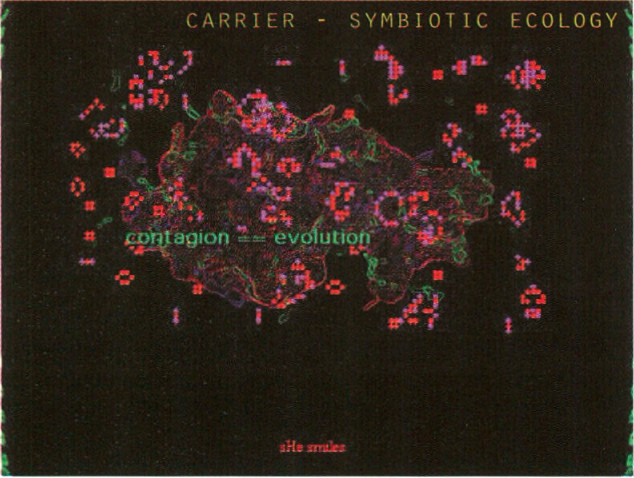
All the same: the cultural value of such a Website is obvious. Although there are still plenty of freshly launched sites that are bursting with boundless naivete in regard to the media and with surplus artistic egomania, there are many non-commercial sites offering added value in terms of their design and content. This can manifest itself in the way new paradigms of interaction are implemented, like in electrica, or in the formation of aesthetic and intellectual individuality, as in the carrier project. And in Jodi's Wolfenstein, when the user is entering a labyrinth-like graphics world, he or she will hopefully rather asks him- or herself: ‘To enjoy or to shoot?’ – and not ‘Is this art?’
The once rigid dividing lines between the Internet and the CD-ROM storage medium are gradually dissolving due to the improved distribution possibilities the Net offers. People are coming to view the Internet more and more as a public and collective data memory, and this economic re-interpretation of the medium is to the benefit of users and media producers alike. Although projects like electrica or fliesstext could be conserved equally well in the form of single-user CD-ROMs, to make media projects accessible over the Internet is consistent with the notion that the Net is a collaborative medium. Even if collaboration does not take place directly among users, to exhibit and make available projects signifies collaboration at a higher level, consisting in the collection of, at best, high-quality media productions and their distribution via channels which are indeed not commercial but in fact idealistic.
Susanne Jaschko, Art Historian and Curator transmediale