Haus der Kulturen der Welt (HKW)
2 February – 5 February 2017
transmediale 2017 conference curator Daphne Dragona explains how the notion of “the middle” underpins this year’s program, considering the changing role of agency alongside the increasingly intertwined nature of the human and nonhuman.
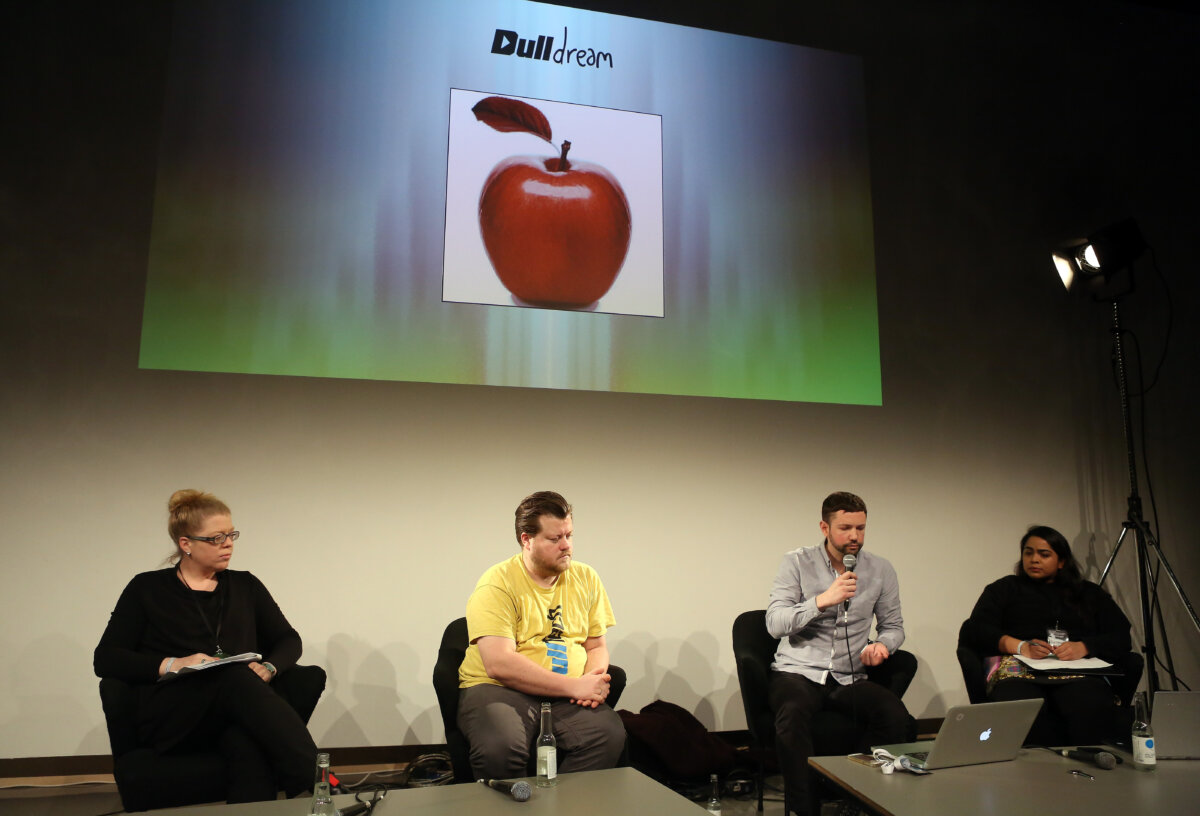
In today’s accelerated condition, it is often difficult to tell where the role of the human ends and that of the machine begins. With machine learning systems, artificial intelligent agents, smart infrastructures, and engineered organisms playing an increasingly important role, new complex techno-ecologies and hybridities continuously evolve. These new entanglements, where technology is felt as natural and mediation becomes immediate, influence the shaping of the economic and socio-political condition, while putting the primacy of human agency into question. How familiar—and how strange—is this becoming autonomous and becoming environmental of technology to its users? How can these emerging machinic ecologies be used and whom can they favour? Which new forms of digital hegemony are being embraced when some actors are filtered or left out of the picture?
Taking these questions as its starting points, the conference of the anniversary edition of transmediale 2017 ever elusive aims to highlight and discuss the different forms of agency that are being involved in today’s fast evolving techno-medial environments and constellations. It delves into various in-between spaces and zones of mediation, consisting of devices, programs, artificial entities, and human involvement, and discusses our role within them. It explores what the challenge of “decentering the human” might mean, taking into consideration optimistic scenarios as well as critical engagements and possible alternatives that might embrace new ways of perceiving the nonhuman.
Of primary importance for this exploration is the notion of the “middle,” used in a way that is twofold. The “middle,” on one hand, describes the complex and multifaceted “in-between” spaces of mediation and agency that result when media expand everywhere, and, on the other, it refers to the repositioning of our role within them. It is used to discuss how by being part of today’s algorithmic filterings and strange ecologies, we inescapably find ourselves in ongoing processes of mediation, and it also underlines the necessity of acknowledging the multiplicity and heterogeneity of such a spaces. With its non-centrality, it holds the potential for transversal practices across sciences, politics, and aesthetics to be initiated.
Following this approach, the speakers of this year’s conference are invited to discuss the changing roles of human and nonhuman agency, addressing this constant middleness and in-betweenness. Theoretical contextualizations, methodologies, practices, and ethics are introduced following three particular directions, three different “middles” as the main conference thematic contexts: The Elemental Middle explores the infrastructural and environmental character of today’s media technologies, revisiting the fundamental relationship of culture to nature; The Alien Middle focuses on the strange and obscure character of today’s mediated environments and re-examines the connection of the human with the machinic; and The Middle to Come emphasises the subtle and sovereign character of today’s mediation, focusing on the emergence of digital colonialism and digital populism, but also underlines the possibilities of other temporalities and spatialities that can formulate what is yet to come.