Haus der Kulturen der Welt (HKW)
05.02 - 24.02.2002
The transmediale.02_exhibition – current positions in media art creates an overview of several fundamental starting points in the production of digital art at the beginning of the 21st century. The artists shown come from Europe, Japan, the USA, and Canada, and determine the interdisciplinary and international character of the exhibition. The exhibits have been produced over the last two years, and all are on show in Berlin for the first time – many will be seen for the first time in Germany.
For the transmediale, this show fulfils the wish that has long been cherished, to show relevant examples of current media art in a broader setting, exhibited over several weeks, and in so doing, to bring them closer to a wider audience. Included are interactive exhibits, which are intended to inspire debate and which draw the visitor into the artistic process, demanding active participation. Video installations seek to break with the habitual forms of perception and netbased works that reflect the media-influenced surroundings and shed a critical light upon them.
The exhibition of the transmediale.02, the very first largescale exhibition showing media art in Berlin, takes place during a highly charged time. The world is beginning to feel the negative effects of the all-encompassing political and economical globalisation, and the media, information and tele-communication industries, after several years of exaggerated optimism, are grappling with a long-lasting slump. At the same time, however, the situation in media art has changed, with the creative use of the new technologies no longer the sole criterion and the artistic concern with the possibilities and aesthetic dimensions of the digital culture finally shifting to the foreground. The cultural environment is tense, while media art itself is gaining contours.
exhibition introduction
_ What is required for such a development is access to well developed sites for production and presentation. Many of the international artists represented at this exhibition may be seen in Germany for the very first time, and it is our hope that the transmediale will continue to offer the possibility of presenting contemporary positions in media art to a broad, art-interested audience.
_ Until very recently, one of the most successful examples of cooperation between art and industry was the Canon ArtLab in Tokyo. Numerous outstanding works were produced at this Japanese lab, largely due to its very unique sponsorship structure, commissioning two works annually, the development of which united company engineers and artists alike. As a result, many artists were eager to work at the Lab; definitely a win-win situation, as many of the works produced there received awards and were shown worldwide.
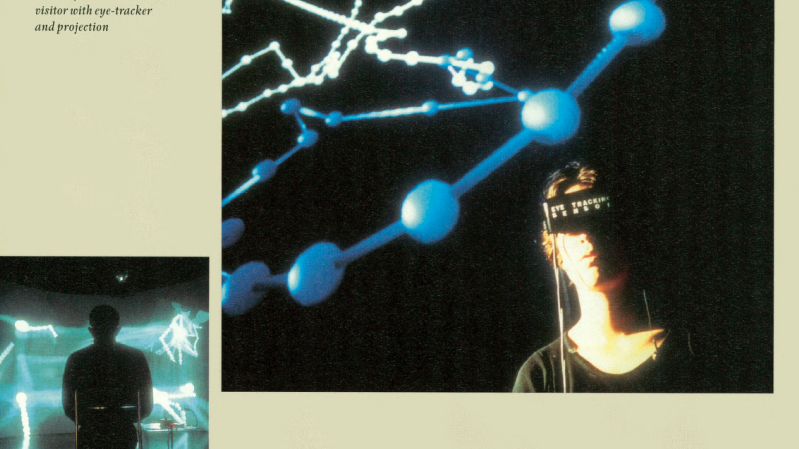
_ Due to economic recession though, the lab was reduced to a minimum in August 2001, something which will surely be felt in years to come. Works such as Seiko Mikami’s Molecular Informatics, shown at this exhibition, depend on technically well-equipped production sites which do not depend on financial viability but are free to support innovative artistic work. The technical solutions that are the result from such work frequently find their application with industrial products, a process which, though it must not be a core concern, is a welcome side-effect.
_ Whether it is supported by public offices or by private industries, media art requires the same unimpeded freedom as any other form of art. Increasingly, it is the artistically orientated media laboratories and producer initiatives or universities and academies seeking to enter media research and design, that are places of media art creation. Artistic productions such as Kenneth Rinaldo’s Autopoiesis, generated at the University of Columbus, Ohio, during several years and exhibited here, need a resourceful and dependable working environment in which artistic and technical development may grow concurrently.
_Actually, today the artistic and technical conditions for first-rate productions are by far better than just a few years ago. The new technologies perform at a higher level and are more affordable, and the know-how shared by artists and technicians corresponds with the understanding of the very complex grammar of media-artistic practice. This also means that it has become easier to differentiate between genuinely artistic work with digital media on one hand, and technically oriented, creative experiments with new interfaces and gadgets on the other hand. For the financial support of media art, even in economically difficult times, the aesthetic power and cultural relevance should always be the decisive factors, instead of commercial mass-appeal.
_ A festival such as the transmediale also has the objective of developing criteria for the description of media-artistic work and to advance the public art-critical discourse. In order to achieve this, we are working with an international jury of experts, relying on a framed grammar for the evaluation of the quality and the differentiation of the variety of genres.
_ The fact that this year it was possible to realise an exhibition for the transmediale.02 which manages to present some of the nominated projects in each of the competition’s categories and various other remarkable works from different areas of research related to media art gives rise to hope: for the artists, who all too often do not find adequate opportunities for presenting their works, and for the festival’s organisers, who for their task of mediating such art depend on a presentation forum. And finally, the audience in Berlin has a chance to savour an encompassing exhibition of substantial media-art productions. The cooperation of the Berlin Kulturveranstaltungs-GmbH/transmediale and Haus der Kulturen der Welt (House of World Cultures) gives an insight into the accomplishments of not only noted protagonists of the international media art, but also features quite a few young and local artists.
_ The show contrasts various artistic approaches and sets them in relation to each other. It does not follow any unifying topic, but in content and form aims at a variegated overview, offering to the audience the opportunity to grasp basic tendencies and correlations.
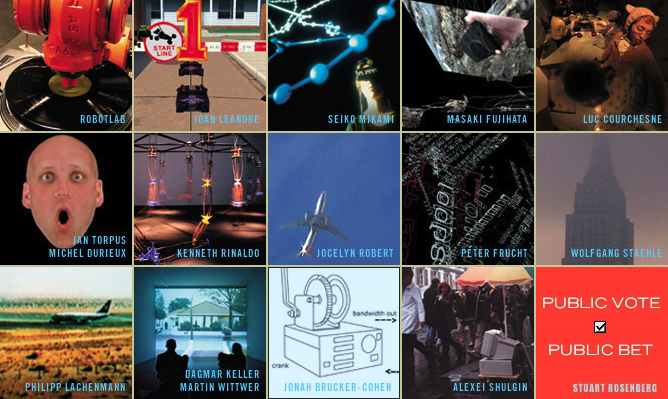
_ Three works which have been nominated for the transmediale Award 2002 have made it to the exhibition. The works by Jocelyn Robert (Image), Joan Leandre (Software) and by Torpus/Durieux (Interaction) mark important and innovative artistic approaches within the three competition categories and exemplify once more the enormous range of the artistic production within electronic media.
_ The digitalisation of today’s image formats contributes to a transformation of the notion of the image itself, a topic which is picked up on by the installative works by Wolfgang Staehle, Philipp Lachenmann and Keller/Wittwer. Additionally, these three exhibition projects deliver a precise description of the state of a hyper-mediatised and traumatised society.
_ The exhibits by Masaki Fujihata and Luc Courchesne each approach in a very individual manner the question of how interaction with a moving image may be generated in such a way as to enable the viewer to experience the plot, and maybe even to play a role in its creation. In order to achieve this it is necessary that viewer and image enter a dynamic, spatial relationship. In Seiko Mikami’s work it is the viewer’s gaze itself which is acting, while at the same time becoming that which is viewed - the activity of seeing is the constitutive basic element of the work, not existing outside of this process. The conceptionally very different robot-sound installations by Kenneth Rinaldo and the robotlab employ machines as methaphors for artificial forms of life. On one hand they confront the visitor with his very own patterns of behavior and expectations, while at the same time fascinating him or her by their inherent perfection and their autonomous presence within the space.
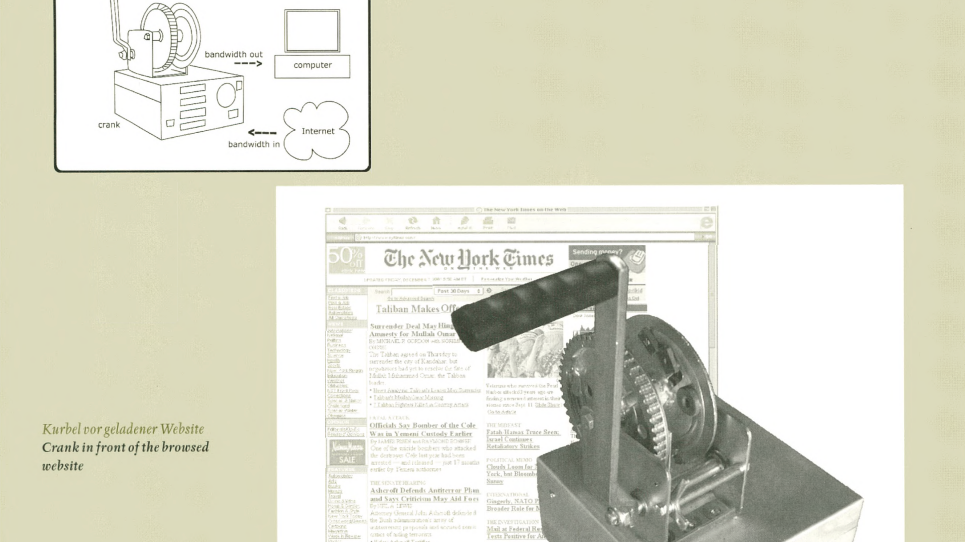
_ The small interactive installation by Jonah Brucker-Cohen and the computer-performance by Alexei Shulgin, placed outside of the gallery, are shrewd comments on the current use of the media and reflect on the evolutionary steps in computer technology in an unusually clear and humorous way. With his net-based installation, Péter Frucht has created a work which critically queries the communication space internet, and makes this otherwise silent space audible. The Public Vote/Public Bet by Stuart Rosenberg finally may be understood as a (self-)ironical critique of the curatorial system and the methods of competition existing in the world of art by empowering the visitor to follow his or her own criteria and to publicly express this personal opinion.
_ In many of its exhibits, this media art show manifests the tendency to treat sound not as a mere accessory, but as an integral part of the artwork. This results in some very special challenges for the exhibition’s organisation, but also exemplifies once more the differentiated levels of reception adressed by media art, something which may be experienced first-hand at the exhibition. Media art therefore not only requires variegated and potent sites of production, but also real spaces and opportunities for exhibitions, at which it may be experienced, understood and questioned critically.
Susanne Jashko

The catalogue includes all of the information on the exhibition and artworks of transmediale.02_exhibition.