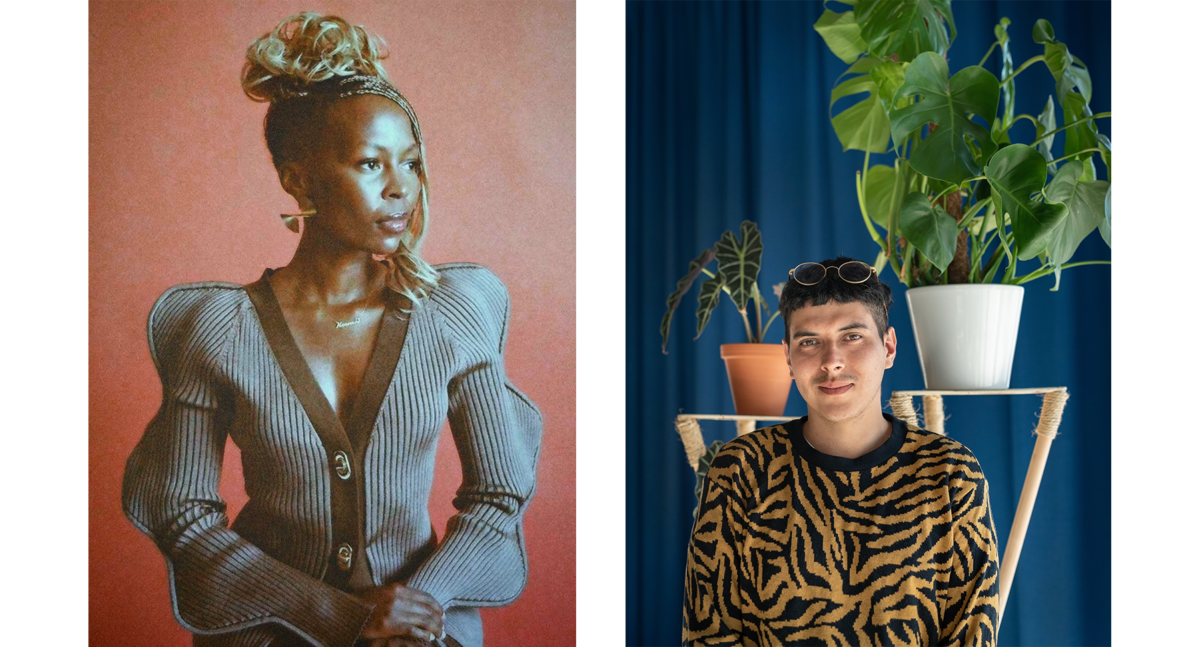
Neema Githere and Juan Pablo García Sossa selected to curate transmediale 2026
We are excited to announce Neema Githere and Juan Pablo García Sossa as transmediale’s 2026 festival curators. The two curators were selected through an open call process, standing out among a large number of applications. Bringing together their broad experiences in curating, organising, and artistic practice, they introduce a dynamic and elastic framework for transmediale 2026, bridging experimental curatorial strategies with critical technological inquiry.
“Our curatorial approach is founded on the understanding that technology is not merely a tool but rather a world-making force – a pluriverse of invocations that sculpt our embodiments across territories and temporalities. We are interested in technology not only as a medium but more as a relational field – a rhythmic space of encounter, negotiation and meaning-making that is always in the process of becoming.”
Neema Githere is a writer, artist, and guerrilla theorist. Neema’s curatorial and research practice examines the digital diaspora and networked repair through cyber-cartography, with a focus on Afropresentism – an inquiry into how descendents of exile can invoke somatic attunement amidst systematised algorithmic displacement. Her work routes decanonising digital methodologies, collective archiving, and reindigenisation through participatory and socially engaged formats. Having dreamt themselves into the world via the internet from an early age, Neema’s work prototypes relationality-as-art through experiments that span curation, community organizing, social design, travel, and image-making. Neema has been building a research-based embodiment practice since 2016; beginning with a project entitled #digitaldiaspora – inspired by Anna Everett’s Digital Diaspora: A Race for Cyberspace (SUNY Press, 2009) – which traveled to over 20 countries exploring how Afrodiasporic creatives were articulating new identities on- and offline.
Juan Pablo García Sossa is a designer, researcher, and expansive media artist. Juan / jpgs’ artistic research practice explores the shaping of cultures, realities, and worlds through the remix and re·appropriation of technologies from a Tropikós perspective (understanding the Tropics as both a region and a mindset). jpgs’ practice is deeply committed to pluriversing technologies towards techno·diversities and more-than-binary perma·computing. Through various netting projects such as Futura Trōpica Netroots, jpgs challenges the homogenising effects of globalism, emphasising relation in difference as in an interPlanetary patchwork of systems and cosmologies. jpgs has developed multiple curatorial projects on and around Post-Development, engaging with emerging digital cultures, grass-root popular cultures, collective intelligences, and the repositioning of realities, deeply informed by networked communities and their evolving imaginative, technological, and emancipatory strategies.
Their combined artistic and curatorial practice focuses on the intersections of digital ecologies, speculative world-building, and questioning dominant methodologies. Both Neema and jpgs bring varied experiences in developing projects with renowned institutions as well as independent and interdependent spaces in Europe, Latin America & the Caribbean, the African Continent, South Asia, and SouthEast Asia.
Their shared vision for transmediale 2026 builds on perspectives from geographies and epistemologies that have been historically marginalised in dominant digital narratives – articulating them into circuits, protocols, and systems of relation. This approach expands the festival’s scope by establishing and reinforcing dialogues between emerging technologies and multipolar situated practices. transmediale 2026 will not be understood as a static event but as a living carrier net – an assemblage of practices, temporalities, and geographies that challenge conventional narratives of progress and innovation. This also entails reimagining experimental infrastructures or containers, knowledge-sharing protocols, and participatory interventions that braid together the complexities of art, computation, and social fabrics.
The two outstanding curators and practitioners have been selected by transmediale’s advisory board consisting of Nora Al-Badri, Asia Bazdyrieva, Gabriele Horn, and Jussi Parikka.
The board comments on the selection: “We were very impressed with their application. All finalists were excellent but Neema and jpgs stood out with their combination of core transmediale themes and new ideas for activities. Their pitch about practicing dexterity across fields of practice resonated a lot, as does their emphasis on pluriversality. One of the key points we want to maintain as a central transmediale element is to establish continuity but also to find other important and future-oriented angles, voices, and participants that can broaden our reach.“
The newly introduced annually rotating curatorial model represents a significant shift in the organisation’s history and a purposeful move toward broadening perspectives in critical discourse surrounding media, art, and digital culture. Neema Githere and Juan Pablo García Sossa will bring their resonant curatorial vision to the festival, shaping this edition while also contributing to the evolving identity of transmediale in the years to come. We are looking forward to welcoming both within the transmediale community.
· · ·
A first outline of the upcoming festival will be announced in July. Alongside the annually changing curatorial model for the festival, transmediale aims for a more sustainable exhibition rhythm, every two years, with preparations already underway for a significant exhibition in 2027. Additional open calls will follow throughout the year, including the selection process for the 2027 festival edition and exhibition.

About transmediale
transmediale is an annual festival and a critical space for the development of new experimental approaches in art and digital culture. Beyond the yearly event, transmediale is a transversal, dynamic platform that facilitates year-round activities including a residency programme and journal. Each festival edition focuses on a specific theme in the spectrum of art and digital culture that is reflected through a great variety of programmes like exhibitions, discourse formats, performances, screenings, and workshops.
Funded by
