transmediale 2017 saw the debut of Bear With Me: A Play For Two Webmasters, written and directed by net.art pioneer Olia Lialina and starring actor and artist Kevin Bewersdorf. Set in 1997, just prior to the dot.com boom and combining live coding with live action, the play follows the efforts of characters Jake, Alan, and Lisa, as they work on their web pages. In December 2016, Lialina and Bewersdorf spoke to Fiona Shipwright, from the Merz Akademie, Stuttgart and upstate New York respectively, about the upcoming performance and how revisiting this previous era of the net can inform our understanding of elusiveness online today.
FS: How did you both come to work together on Bear With Me ?
OL: Before we met in person, we were part of the same Surf Clubs around 2005/2006, Nasty Nets and Spirit Surfers. We were surfing the net “next” to each other and sharing what we found there. When I knew I wanted to stage Bear With Me, I was writing it for him. I should say though—and I think he will agree—that the character Kev plays is not based on him.
KB: I first became aware of Olia through an essay that she had written called “A Vernacular Web” [2005], which inspired some of my work. Then I met her at a gallery where we were both showing and became friends. We kept in touch over the years and then she told me she had written this thing she’d liked me to do. I have great respect for her, so I of course agreed. Plus, it would mean I would get a chance to come back to Berlin, where I haven’t been for over ten years.
I think you will notice some changes…
KB: That idea is actually partly what the play is about, the sense of moving to a neighborhood in a city—Berlin and New York are both good examples—with this pioneer spirit, because it feels like a frontier. You’re there for ten years and then suddenly everything changes and bitterness arises, the sense of “but I was here first and these people are coming in and changing my neighborhood.” That’s what this play is about: the neighborhood is an online community and the city is the internet.
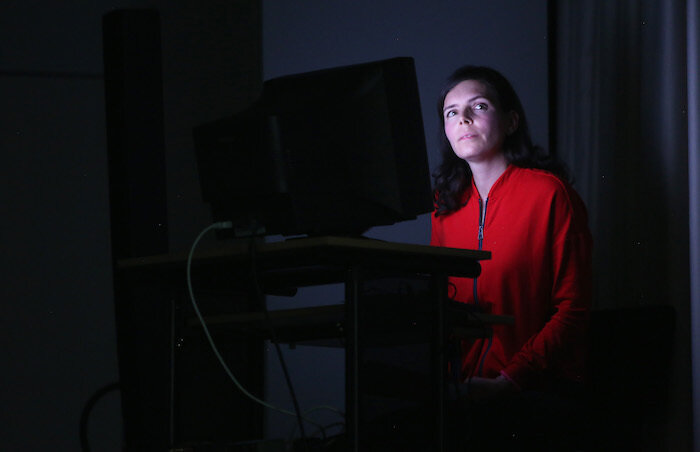
Olia, you’ve played with narrative in the past but this is your first live-action theater piece. While it can be documented, it’s primarily a medium one has to be present for. Were you interested in resisting its documentation?
OL: Well, not only will the play be live-action, there will also be simultaneous live coding onstage. I don’t know which makes me more nervous! There’s no chance for mistakes. But rather than resisting documentation, it’s more that I am playing with this aspect of contemporary online culture where only what’s right now matters at any given moment.
There’s also another layer, a connection between time and speed; the play takes place in 1997, an era of very slow internet connections. At that time I was making narratives for the browser and feeling a little like a stage designer, because I had the same limitations: limited time and space in which to build something and represent a richer environment. With Bear With Me I am making similar decisions for the stage. Though I have worked with web narration for a long time, it’s only now that I have become “grown-up” enough to make the step to theater. And it’s not only me that has grown up. The web is now such a mature medium, visually and acoustically. It has a history that you can now bring to another medium.
What made you set it at the height of the first browser war —a time when when Microsoft’s Internet Explorer was vying to be the most popular browser against Netscape Navigator, which effectively stemmed the tide of innovation that had characterized the early web?
OL: For many people I’m associated with my 1996 work My Boyfriend Came Back from the War . I’ve always spoken about this idea that one internet year is equal to ten but that there is a century between 1996 and 1997. So many things happened then. 1997 was the beginning of dot com and the issue ofWired magazine that appears onstage in the play announces this new world that was coming. What I remember personally from 1997, when I was living in Moscow, was a dramatic drop the in the price of an internet connection. It became affordable for the first time. Then there were the new versions of browsers at that time, part of the shift from page-making to application-making. The IT industry formulated a very clear message: forget webpages, kiss your browser goodbye, something else is coming. After three years of motivating people to make their webpages and encouraging young entrepreneurs to do the same, they were just saying “forget it.”
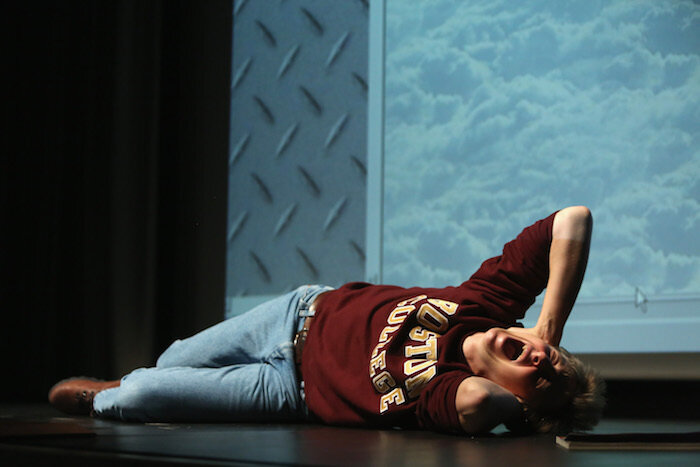
The strapline for Bear With Me is: “a play for two webmasters.” Olia, you’ve written before about the development of the term “user” in the age of invisible computing—but what about the term “webmaster”? Is the term now obsolete?
OL: In Russian the word master is used to describe a person who can do things perfectly, a wizard, somebody from whom you can learn. But I remember when I myself was a webmaster in a design company, in early 1997. A webmaster was the position below the web designer, the people working with the code to make what the web designer envisioned possible. I think that those people who were web masters became web developers. So “mastering the web” was a very important occupation. As a non-native English speaker I am thinking now about other constructions that include the word “master,” because I always think of that word implying that you have “mastered” something, that you have become the boss of your medium.
KB: Yeah, the master was really involved in the nitty-gritty, day-to-day kind of bullshit stuff, cleaning the pool and weeding the garden. It was almost like a term to hype them up without cause so they felt that they were very important when they maybe weren’t actually that integral to the whole thing. But then there’s the master-slave relationship thing that is really fucked up, plus the fact that any true master would never claim to be a master anyway.
OL: For me now, there are unfortunately so few people who can master this medium. The play happens during the moment that people were writing a narrative themselves—there was no interface that would make a timeline out of your communication or the story of your life out of your communication.
KB: I love the term and I’ve thought about what it has meant at different times, but as for who I would say is a webmaster now, I’m not sure. A master has to have discipline and I think a lot of the way people are using the internet now is undisciplined or fairly undisciplined. I would say that Olia is, to me, the closest that I have known to a master. With Bear With Me, the funny thing about one character, Alan, is that he believes he really is a master and that people don’t give their masters their due respect. I think it’s relatable to other aspects of our lives; everybody feels in some way that they’re not given their due respect for what they’ve accomplished, that idea of “you don’t know what I’ve been though, what I can do and how hard I’ve worked for this.” But when you see this play and you hear him go through his thought process, he’s humanized to a point where he’s really just like anyone else.
As more and more digital and internet infrastructure gets hidden under the bonnet, perhaps that that kind “what I’ve done” evidence of isn’t there to show people. Does that matter?
KB: In the era of the internet in which the play is set, there were these badges that you could clearly wear. People would have a little “my awards” section on their pages and the webmasters would hand out awards to each like the academy awards. You’d have like “Star Trek Site of the Month” and there’d be a little badge and the webmaster could be like “that’s me, I won!” These guys were operating in this pioneer zone with very few people out there and so they had to hype each other up by giving out awards, claiming the title of “webmaster” and developing the lingo that could separate them as an elite mater class within the internet. But then when the pace of that battle intensified into something that’s 24/7, there’s no more handing out of awards, no more regalia or decorations—it’s just what everybody does. So they lost that, which is very sad. It’s a bit like going to a veteran’s post and taking away all of their awards and saying, “actually, everybody’s a war hero now, all your wars don’t really matter, I’m just going to take away all your medals.” That must have been quite a realization, that’s nobody’s a “veteran” anymore, that everybody’s fighting.

Bear With Mewill next be performed at The Kitchen in New York City — watch the trailer here .