There are oh-so-many metaphors by which people try to understand the haphazardness of a life. It might sound like a banality to point out how important these structuring stories and overarching images are to the retroactive and projected constitution of one’s own sense of one’s own history—but like most seemingly banal things, it’s not. (George Lakoff and Mark Johnson even wrote a three hundred page book about the all important “Metaphors We Live By”1 .) The sheer multitude of decisions, modulations, retractions, sensitivities, adoptions, actions, and inactions that constitute a life really requires, for most of us, some kind of figurative parable or narrative curve-fitting. This, in part, is what helps each of us find momentary answers to the central question of “what is to be done?” or at least “what is to be done next?”
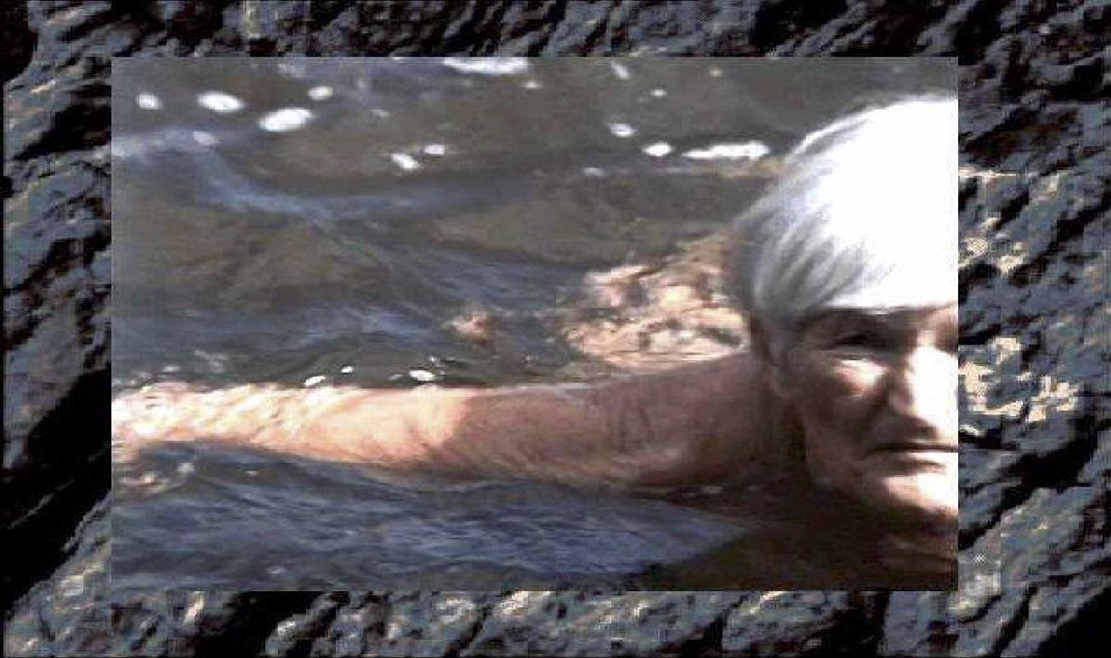
IMAGE:Hot Chicks on T.V. [video still] by Elizabeth Van der Zaag.https://archive.transmediale.de/sites/default/files/public/imce/nodes/Journal/Blogpost_07_07_2016_HotChicks.PNG <a href=https://vimeo.com/39432305><i>Hot Chicks on T.V. (1986)</i></a> [video still] by Elizabeth Van der Zaag. A frantic collage of images of women negotiating their own images, identities and activities, replete with disjointed mid-1980s computer graphics compositing, presenting attempts to 'keep up' agaist ever higher standards of perfection, are juxtaposed with the serene wisdom of a calm, older woman who has found a way of navigating these pressures.
But how should our idiosyncratic existential blips be best metaphorized to produce a life of love, knowledge, friendship, work (not job), and knowing? Should we imagine an erratic or peripatetic random walk? A perfectionistic, hylomorphic self-sculpting and soin de soi? A deterministic, individual pilgrimage toward some specific end or goal? There are a host of trite Americanisms that would have people posit their lives as a kind of personalised capture-the-flag game—life as “finding yourself.” As if the “real you” was a kind of emerald jewel, thrown away at the moment of your birth and lying in wait in some dark, subcontinental jungle, forever rendering human experience as an isolative idiosyncratic treasure hunt (which maybe explains The Amazing Race ). A wonderfully brilliant New York historian, feminist and designer I had the privilege to work with for a while used to rail against the seemingly blameless, widespread life-metaphor of the “timeline”; to her, this omnipresent spatio-temporal diagrammatic was both dishonestly mono-chronometric (time, especially life-time as experienced, is not linear, but dynamic and relative) and a violent collapse of parallelism and synchronicity (lots of things happen at the same time, all the time). “Timelines are a lie,” she would say, fervently and often.
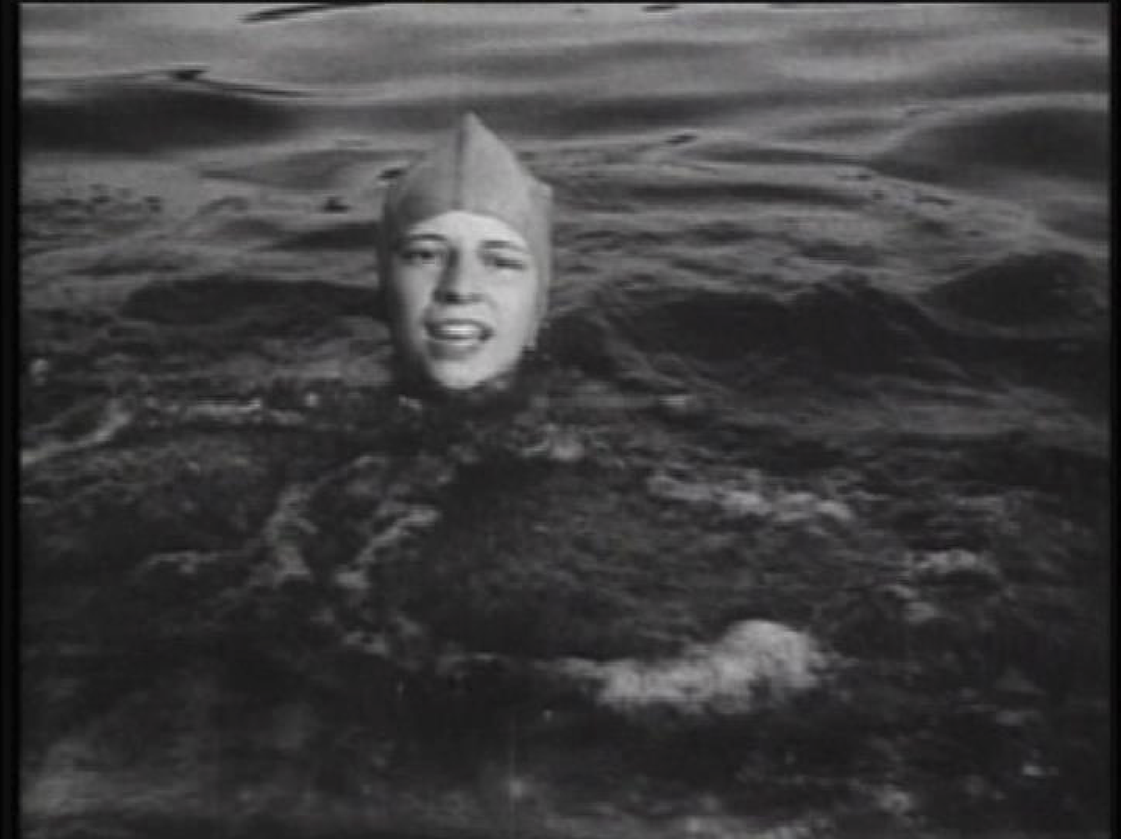
IMAGE:Our Marilyn (1987) [video still] by Brenda Longfellow.https://archive.transmediale.de/sites/default/files/public/imce/nodes/Journal/Blogpost_07_07_2016_OurMarilyn.PNG <a href=https://vimeo.com/105520959><i>Our Marilyn</i></a> (1987) [video still] by Brenda Longfellow. The film contrasts a Canadian and an American figure of the heroine: Marilyn Bell, an unknown athlete from Toronto who became the first person to swim across Lake Ontario, and Marilyn Monroe, as she entertained U.S. troops in Korea.
On 2 February 2016, the Canadian artist, activist, feminist, designer and current Ontario College of Art and Design President Sara Diamond delivered the 2016 transmediale Marshall McLuhan Lecture. Sara was asked by festival director Kristoffer Gansing to review her life as an activist and instigator—in a way, to narrate her autobiography. Sara also chose to respond directly to transmediale’s festival theme-cum-prompt “anxious to…” (Anxious to Act, Anxious to Make, Anxious to Share, Anxious to Secure being the conference stream titles). Having initially titled the lecture, “Anxious To See Change,” just before the lecture event Diamond seemingly subtly re-titled her talk to “Anxious to Sea Change.” As I saw this new spelling on a title graphic projected above the stage at the Canadian Embassy in Berlin during an afternoon pre-lecture sound check, it struck me just how appropriate this shift to nautical metaphors was for a lecture that was to review a lifetime of individual passions becoming institutional practices that have modulated a generation of art, media, design, and technoscience practice and research in Canada and elsewhere.
Diamond has made her career in one of Earth’s few nations that is touched by its two largest oceans, making all the more propitious the examination during her lecture of a number of important “ships”: scholarship, membership, friendship, censorship, citizenship. Her lecture, as her work and life, strikes one with the impression of an admirable someone who is adept at building and maintaining institutional vessels that are resilient and durable, and that shelter the concerns and transport the voices of suppressed intersectional identities therein: women, racial minorities, indigenous cultures, and the LGBTQ community. Sara Diamond’s spheres of engagement, throughout her continuing, active career in art, design, and technoscience, are marked by an inspiring ability to mould and modulate environments, always stemming from a consistent intent to bring to the fore the concerns of the under-represented and unheard.
Central to the buoyancy of a ship is the collaborative tenacity with which it negotiates the medium of its own travel. The “sea change” Diamond refers to is precisely this kind of inventive use of the tensions between a being and its milieux, the tensions between individuals and institutions that simultaneously empower and enervate. She models a powerful persistence in the face of lasting, lapping frustration that change never comes soon enough. In the anticipative institutions Diamond builds and maintains, we see how lasting reorientation and indeed healingcan only take place through contexts, in art and design as elsewhere, that span beyond the modernist trope of the ‘creative individual’. Such reorientation is nonetheless and contradictorily dependant upon the imaginative energies of individuals and smaller, empowered collectives. This essential resonance is a dynamic that leaves many of us “out at sea,” unsure if inclusion, equality, participation, and visibility are goals best advanced through change articulated from inside or outside “the system.” The methods available to us to change whole contexts, worldviews and histories—producing sea changes—often seem to breed little but fatigue and cynicism. Do we expect too much, and too much immediacy? The simple answer to the supposed choice we must make between becoming internalised and externalised forcing function is: do both.
IMAGE:The lull Before the Storm (1990) [video still] by Sara Diamond.https://archive.transmediale.de/sites/default/files/public/imce/nodes/Journal/Blogpost_07_07_2016_TheLullBeforeTheStorm.PNG <a href=http://www.tacticalmediafiles.net/videos/4446/><i>The Lull Before the Storm</i></a> (1990) [video still] written, produced and directed by Sara Diamond. Dorothy (center) is a fictionalized working-class wife whose curtailed interests and thwarted goals develop into obsessive-compulsive disorders until she finds her own cure, by going back to work and leaving her boys in front of the TV and their TV dinners.

According to Diamond, reconstituted identity politics can only be developed in the shell of the old—there is no cure without a cut, no hope without frustration, no therapy without the anxiety of trauma. Avital Ronell has similarly pointed out how the invective complaint of the “young girl” is summarily dismissed by cool, rational narratives of masculine progress.2 To the ears of the patriarchy, the recurrence and repetitiveness of these necessary complaints should be annoying. A trauma of being female in “our” culture lies not simply in the many individual inequalities and objectifications suffered, but that these also produce fears of their reenactment. Dialogue, discourse, discussion—talking cures—are amongst the ways we can deal with this fear of recurrence. The continuing need, for example, to assert that women should be in roles of leadership in media production, is not cause for exasperation or despair but for a strengthening of both the hope and the frustration that are necessary to curative invention and creativity. Diamond’s lecture narrated a number of these kinds of resonant antagonisms of pathology and healing, of imbalance and restitution, over her lifetime of feminist activism, art, and institution (re)building. She outlined the anxieties and reactive cures of a number of trauma sites: women’s own bodies (birth control, choice in family and domestic violence); labor (the home and public spaces occupied by the underpaid and overworked); the struggle to control media production and representations (degrading and isolative depictions of women); the depiction of and enactment of racism (systemic discrimination and stereotyping through images); the indigenous experience (forced loss of identity and destruction of environment and hence livelihood); sex (diversity of choice and lesbianism as a political or sexual choice).
Our “Age of Anxiety,” as W.H. Auden called it in 1948, seems to be entering its second century, Sara suggests perhaps even as the self-fulfilling diagnosis of an over-reaching pharmaceutical industry. This gives Diamond cause to frame activism, technology, and art as responses to trauma. In Freudian and psychoanalytic terms she even refers to these as a kind of 'talking cure' (whether in voice, text or other media). From the support of collectives and communities, to the impulse activating and programming cultural and educational institutions, the not-only-etymological link between security and curation is wrought. Activism, media, art and design practices can and should be curative, reassertions of our continued responsibility to one another as partners in reparative dialogue.
IMAGE:T.W.U. Tel (1981) [video still]https://archive.transmediale.de/sites/default/files/public/imce/nodes/Journal/Blogpost_07_07_2016_TWUTel.PNG <a href=http://videoout.ca/catalog/twu-tel><i>T.W.U . Tel</i></a> (1981) [video still]. This documentary by the feminist film collective Amelia Productions reports on the over-supervised work conditions and eventual worker’s takeover of British Columbia telecommunications systems in 1981.
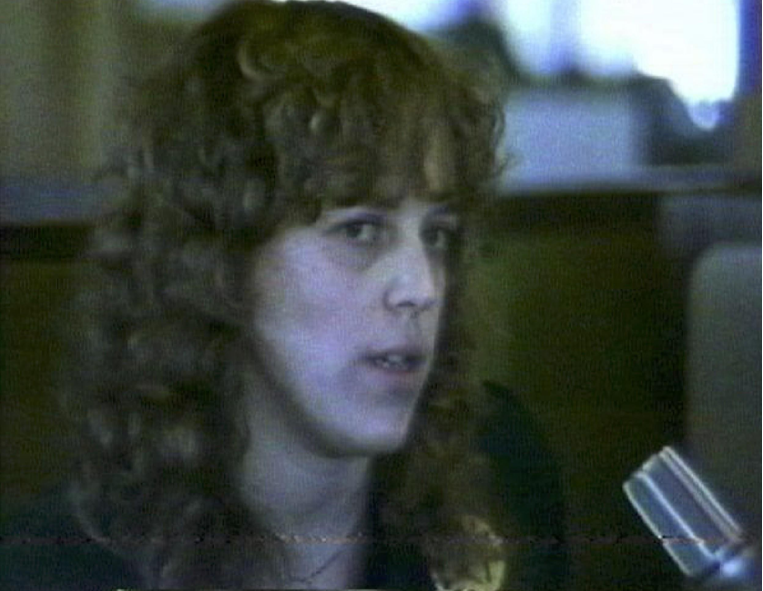
A period that captures well the intersectional concerns of Diamond’s entanglements is her work with the feminist documentary team Amelia Productions (Billie Carroll, Sarah Davidson, Sara Diamond, Ellen Frank and Gay Hawley) through the late 1970s and early 1980s in Vancouver. As a member of this collective, Diamond contributed to what is probably the earliest “dyke-activist” videotape in Canada and produced a dozen or so other tapes that were half-derisively dubbed “occupational videos,” as they often documented and constituted people occupying a place of work. Lesbians Against The Right (1981) explored personal-political resonances of homosexual identities, lifestyles, and activism, and T.W.U. Tel (1981) translated a scene of occupation and operation of British Columbian telephone centres by that province’s Tele-Communications Workers Union membership.
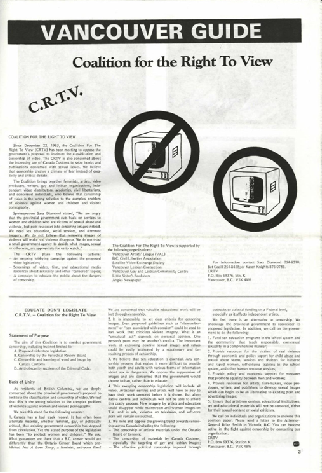
Later in the 1980s, Karen Night and Diamond would become the voice of a focused institution called The Coalition for the Right to View (C.R.T.V.) in Vancouver, begun as a means of countering proposed B.C. Motion Picture Act censorship legislation. Interestingly, Diamond’s involvement in censorship issues began in her protests against the pornography industry, playing out an issue that still remains divisive in the women’s movement more broadly. Diamond’s own shift toward becoming an ardent anti-censorship campaigner came when she realized she was sharing the picket lines outside of international Vancouver-based porn distributor Red Hot Video with the religious right: “I was walking with the enemy, which is much less interesting than sleeping with the enemy.
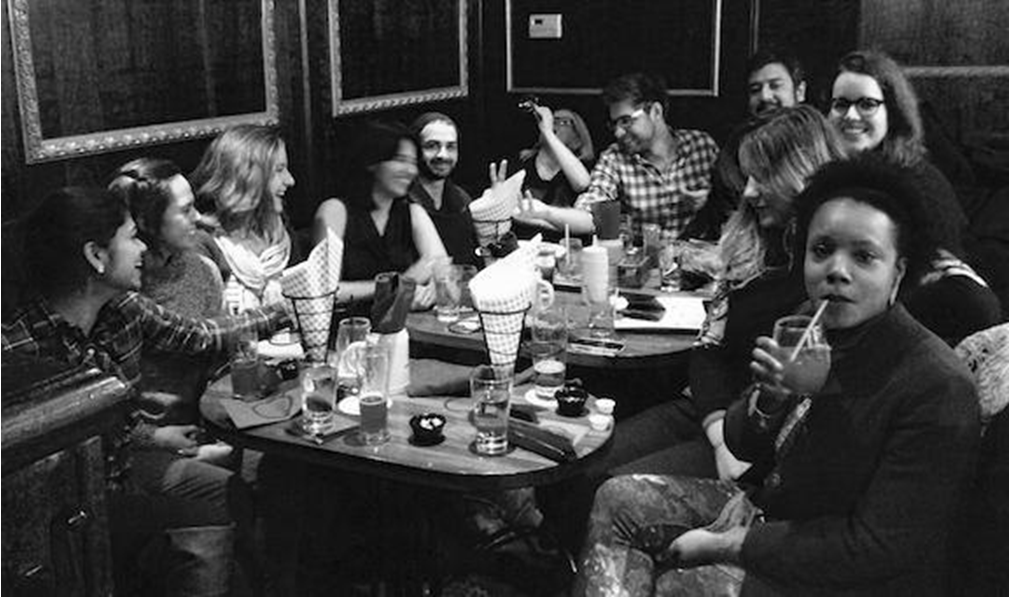
IMAGE: https://archive.transmediale.de/sites/default/files/public/imce/nodes/Journal/Blogpost_07_07_2016_FemTechNet.PNG Celebratory completion party for the Distributed Open Collaborative Course format developed through <a href=http://femtechnet.org/2015/05/femtechnet-roadshow-blog-series-distributed/>FemTechNet.org</a > and the Ontario College of Art and Design University in Toronto, Ontario, April, 2015
Perhaps a suitable life-metaphor we could fit to the work, life and passions recounted by Sara during her lecture on that evening in February at the Canadian Embassy in Berlin is that of Theseus’ famous ship3 . It is a parable that treats the necessarily constitution and reconstitution of identities, along with its presentation and re-presentation, as a continuous practice of the self with others. These are the high expectations we should reserve for that unfortunately much maligned descriptor, “creativity”4 . That is, or ought to be, a requirement to articulate and invent new dynamics that transform the self along with the communities, institutions, seas, environments in which they are always embedded, and to which they are always responsible. Diamond’s Mcluhan Lecture inspires and reminds us that consistent objectives and style need not come at the expense of reinventive approaches that are invigorative, pragmatic and prefigurative. The tenacious ship at sea serves as a metaphor for a life of identification without calcification, of resolute commitment without conservatism in the face of recurrent, entrenched injustices. The audacious seacraft, carefully sustained and lovingly maintained, spiritedly instigates and navigates seas of change.
The message of Sara’s lecture, although to be sure a call for a “dramatic shift of winds and direction that can help us to sail free of debris yet remain buoyant” was not at all rhetorical. Her examples of projects and initiatives, actions and interventions, remind that we cannot replace the hard work of keeping subjugated identities afloat with mere techno-manifestos or the interminable pronouncement of paradigm shifts. The always reiterated call for change she makes is one that accepts both hope and frustration as part of struggles for sexual, racial, personal, and collective agency, in the appreciation and cultivation of ever greater difference in our world. The work of making technologies and art, designing hardware and writing code, just as with the labor of sharing knowledge and building institutional forms, is forever better when bathed in such richly diverse, heterogeneous waters. A reflection on a lifetime of feminist activism spanning practices personal, artistic, and organisational, her lecture narrated the necessity of anxieties and antagonisms, as an interplay of malady and healing, of imbalance and restitution, constitutive of all things vibrant, alive, and in progress.
- 1 Lakoff, George, and Mark Johnson. Metaphors we live by. University of Chicago press, 2008.
- 2 Ronell, Avital. « The Shock of Puberty. » European Graduate School Lecture, 2011.https://www.youtube.com/watch?v=kj60bq4ZYEs .
- 3 The story of the Ship of Theseus is a kind of classic ontological-flumoxer in which Theseus is asked by a some rich guy to make a boat exactly like his own. He gets all the stuff together he would need to do this with — boards of wood that have precisely the same knots and grain in them, pieces of canvas with exactly the same warp and weft of his own sails. While on the journey to the kingdom where this boat is to be built, Theseus starts having problems with his own ship, and needs to replace bits here and there. Planks pop out of place and booms rot out, but luckily he’s got the right parts around to replace these elements. By the time the vessel and its captain get to their destination, the entire ship has been rebuilt with parts identical to those replaced. The question of whether the boat is authentic, original or identical to the original has been the subject of much philosophical musings, and people like Michel Foucault and Gilles Deleuze picked up this maritime allegory to describe how a wholesale transformation of social identity might take place that remains genuine and and rooted in biography. While encouraging identities to morph and transmute, we can remain linked to both our histories and authentic experience in the present, and, at the same time, meaningful, thoroughgoing change never occurs all at once.
- 4 As my friend Bernhard Garnicnig said to me recently, “What does it say of our current moment that artists are uncomfortable using the word ‘creativity’?”