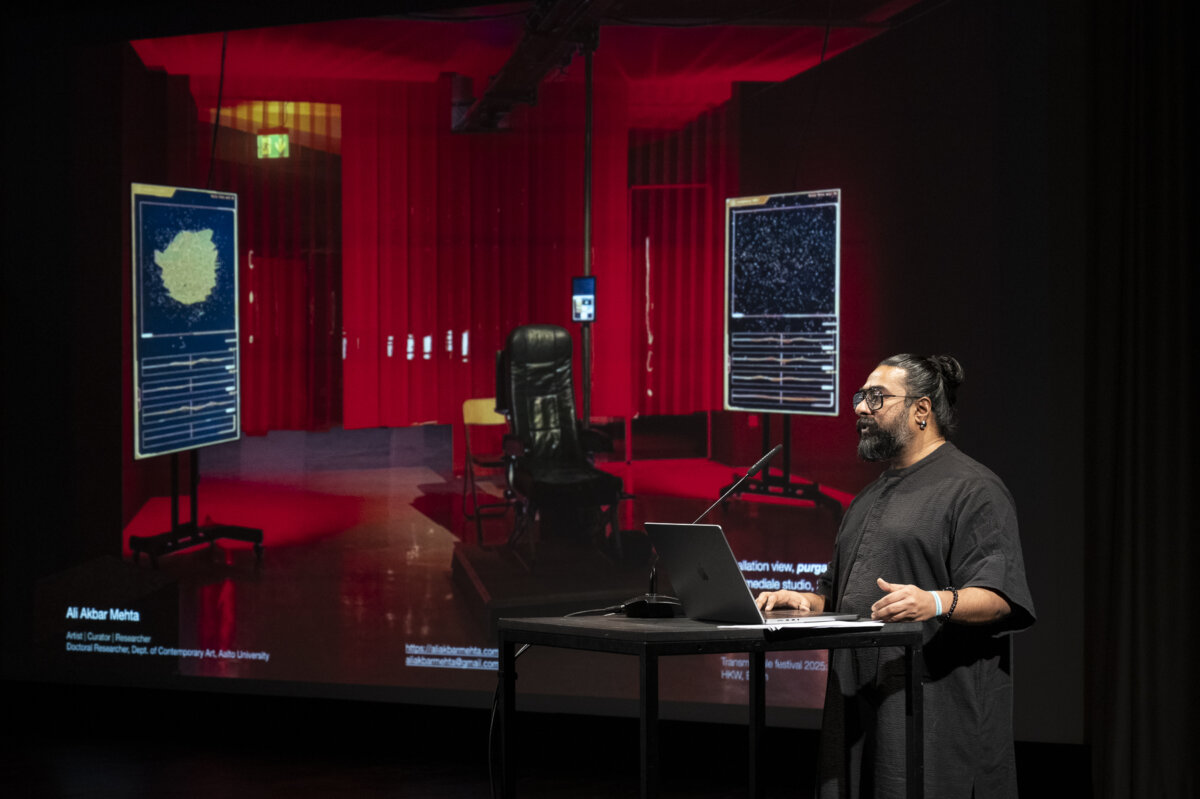
A traditional linear concept of time is no longer sufficient to capture the complexities of contemporary digital archives and their narratives. The lecture Living in ‘Archival Time’, or at the End of Narrative(s) by Ali Akbar Metha explores the complex relationships between archives, time, narratology, and its various media. With an introduction by and followed by a conversation with Peter Zorn.
The concept of archives has evolved from traditional institutional frameworks to increasingly corporatised digital models shaped by neoliberalism, extractivism, and surveillance capitalism, turning archives into tools of power and control. This shift redefines our relationship with time and storytelling, challenging Western frameworks, and embracing multiplicity and non-linear narratives enabled by digital archives. Similarly, databases disrupt traditional narrative structures, replacing them with interconnected models that reshape how we engage with history, memory, and experience in the digital age. Together, these ideas reveal the normalisation of timeline manipulations, blurring the boundaries between reality and a form of digital time travel. By drawing on the multiplicities of archives and the time-traveling of databases, Mehta proposes a critical analysis of the evolving nature of archives.
The lecture contextualises Mehta’s interactive installation currently on view at transmediale studio: purgatory EDIT– Liberation Archives for the Cyborgs of Now (2022–ongoing) is a user-generated, montage-based cinematic experience centered on the artist-assembled Doomscroll Archive. Investigating the glorification of violence in visual media, this archive is a collection of over 40,000 visual entries sourced from war footage, cinema, online content, and personal archives. Visitors of the installation engage in an immersive cyber performance using portable EEG technology, where their brainwaves influence real-time sequencing of the archive, creating individual montages. Purgatory EDIT examines the role of artistic imagination in shaping politics and speculative futures by critically reflecting how media influences our understanding of power, identity, and freedom.
Purgatory EDIT was part of the group show UnNatural Encounters on view from January 9 to 19, 2025 at silent green, and transmediale festival 2025, (near) near but — far, taking place from January 30 to February 2, 2025. The project is presented by transmediale 2025 in collaboration with European Media Art Platform (EMAP) and silent green Film Feld Forschung, Purgatory EDIT has received development support from the European Media Art Platforms residency program 2024 at Werkleitz co-funded by the European Union. The lecture is a collaboration between trasmediale and Werkleitz.