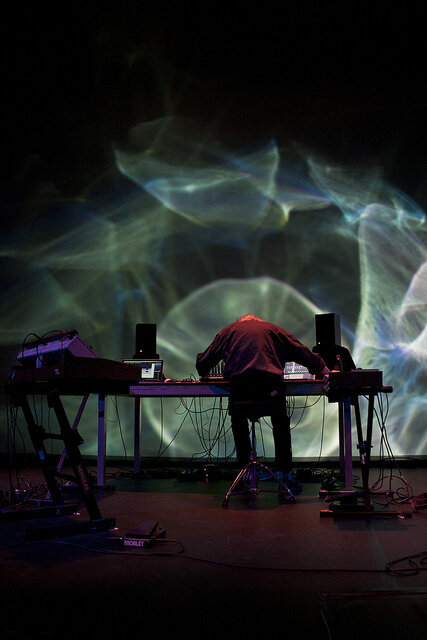
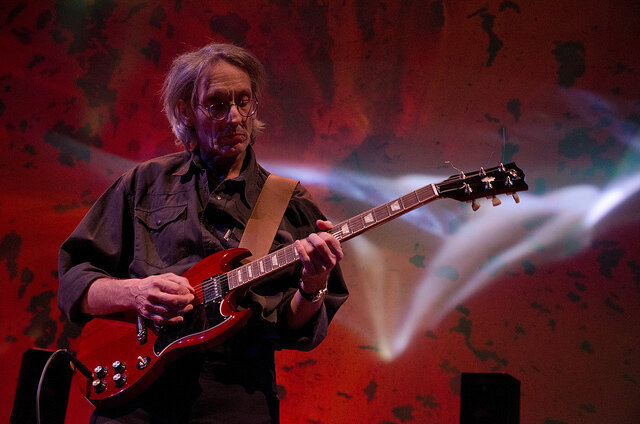
Tonight The Joshua Light Show appears for the last time at transmediale 2012. Being the particular highlight of the performance series they will perform together with pioneering guitarist and electronic musician Manuel Göttsching (de). Over and above the notable visual accompaniment by New York’s Joshua Light Show, there is a special historical fiction surrounding Göttsching’s appearance at the HKW, an iconic venue of Berlin’s landscape that is instantly remarkable for its spacious and very open room-design and its hallmark curved roof. Boasting a full performance schedule as of its opening, the HKW on November 11 1979 the HKW hosted a fashion happening featuring Berlin designers Claudia Skoda and Tabea Blumenschein in its main hall. Entitled "Big Birds", the event was supported by a live soundtrack specially-composed and performed by Manuel Göttsching.
Göttsching performed his heavy metal-inspired electronic soundtrack only on analog synth gear that evening, and amplified its power through a sound system that he had alleged purchased from Pink Floyd. Rumour has it that Göttsching’s performance that night was so powerful as to cause concert officials to worry as to the roof's structural integrity. The building subsequently closed its public activities while reassessing what precautions to take. The move proved quite wise, as shortly thereafter, in May 1980, the roof indeed collapsed - killing one journalist that got caught under the debris. How big of a disaster, then, did Göttsching’s fateful performance potentially avert?
While the HKW has since been reinforced and renovated up to modern safety standards, expect to walk away with no less of a powerful impression from Göttsching’s performance, for which he will be bringing out his full arsenal of original analogue equipment, to recreate a soundtrack similar to that which he performed back in 1979. Göttsching will also be performing analog-only music relating to his own compositions of that same time period, such as the celebrated Dream and Desire album of 1977.
Manuel Göttsching (de)
Manuel Göttsching’s career spans over 40 years. First known in the early 1970s as a founder of the German cosmic rockers Ash Ra Tempel – later known as Ashra – Göttsching earned a reputation with his usually atmospheric and subtle guitar work. After a number of albums throughout the 70s, Göttsching's most decisive and enduring work was released in 1984: E2-E4, a masterpiece of economy. Its hypnotic, treated synth and drum machine loop morphs and unfolds gradually over the entire first side of the album without ever loosing focus – before side two continues with Göttsching’s unique guitar-playing, which unpretentiously blends into the soundscape. With its stringent funkiness and minimalist sonic precision, it became a touchstone for much of the electronic dance music that would later emerge from Germany and internationally. Göttsching has remained active throughout the years while maintaining his position as grand seigneur of Krautrock, cosmic and minimal music. In December his image graced the cover of The Wire.
This event is a collaboration between transmediale and CTM – Festival for Adventurous Music and Related Arts.
(Images: Manuel Göttsching at Berghain, 12 December 2006, © Matthias Roeing, www.ashra.com/news.php / Manuel Göttsching Feb 1973 Paris, © MG.ART Photo: Marcel Fugère, www.ashra.com/news.php)
Heute Abend erscheint die Joshua Light Show das letzte Mal bei der transmediale 2012. Als besonderes Highlight der drei Auftritte spielen sie heute gemeinsam mit dem Gitaristen und Elektronik-Pionier Manuel Göttsching (de).
Manuel Göttsching (de)
Manuel Göttsching ist schon seit mehr als 40 Jahren musikalisch mit dabei. Zuerst machte sich Göttsching in den frühen 1970er Jahren einen Namen, als er die deutsche Cosmic Rockband Ash Ra Tempel – später nur noch Ashra – gründete und durch sein ungewöhnlich atmosphärisches, vor allem filigranes Gitarrenspiel begeisterte. Nach mehreren Releases in den 70ern, kam 1984 mit E2-E4 Göttschings populärstes Album heraus, ein ökonomisches Meisterwerk. Sein hypnotischer Synth- und Drum Machine Loop wandelt und entfaltet sich langsam und stetig über die gesamte erste Seite der Platte, ohne den Fokus zu verlieren. Auf der 2. Seite setzt Göttschings unvergleichliche Gitarre ein, die sich unprätentiös in den Gesamtklang einfügt. Mit seiner stringenten Funkiness und minimalistisch-tonalen Präzision wurde das Werk für die spätere elektronische Musik aus Deutschland und anderen Ländern zu einem wahren Meilenstein. Göttsching selbst blieb während der ganzen Zeit als Musiker aktiv und erfreut sich heute der Rolle eines Grand Seigneurs des Krautrock, der Cosmic und Minimal Music. Sein Foto zierte das Cover der Dezember-Ausgabe der Zeitschrift The Wire.
Diese Veranstaltung ist eine Zusammenarbeit zwischen transmediale and CTM – Festival for Adventurous Music and Related Arts.
(Images: Manuel Göttsching at Berghain, 12 December 2006, © Matthias Roeing, www.ashra.com/news.php / Manuel Göttsching Feb 1973 Paris, © MG.ART Photo: Marcel Fugère, www.ashra.com/news.php)