Nasi kerabu is a dish originating from the Malay Archipelago. It is found in southern Thailand and along its border, under the name Khao Yam. It embodies the act of foraging in the home garden – a careful, attentive gesture in a space that is both nourishing and nurturing. One does not harvest, one gathers. Eating and preparing nasi kerabu is a way to experience the territory, to understand its tropical intertwinement, and to recognize cooking as a living, sensitive, and political language. The rice takes on the color of Clitoria ternatea, a flower that dyes it a blue reminiscent of both the sky and the sea. The plants become edible archives, forming a culinary memory that bears witness to cultures that predate the creation of nation-states. In traditional practice, there is a superstition that the number of herbs must be odd – 7, 9, 11, or 13 – believed to enhance the balance and harmony of the dish.
Nasi kerabu will be accompanied by breadfruit ( สาเก / Sukun) a fruit that followed Austronesian migrations and later the routes of colonial slavery. Today, this fruit is found throughout the Pacific, Southeast Asia, and the Caribbean, exhibiting culinary variations across different cultures. The breadfruit (Artocarpus altilis) spread along the routes of Austronesian migrations long before it later followed the paths of European slave trading. Named breadfruit by Europeans, this food has been a vital staple in Austronesian diets for over three thousand years, valued for its high nutritional content. In the eighteenth century, it was transported across the seas to the Caribbean to feed enslaved populations. Even today, despite its new status as a superfood, breadfruit remains an ingredient of survival. In many of its regions of origin, its consumption is in decline. Its so-called “recalcitrant” nature – its seeds cannot be easily stored, and some varieties produce none at all, reproducing only through cuttings – has likely relegated it to the margins of agricultural and state systems of production.
The Green Revolution, particularly in Southeast Asia, established rice as the first-class grain. Although rice had long been part of the Asian diet, it had never been cultivated or consumed on such a massive scale. Certain varieties now yield up to three harvests per year, transforming agricultural landscapes and food systems. In Against the grain James C. Scott observes that the earliest states were built upon the cultivation of grains that are quantifiable, storable, and taxable, all qualities that made centralisation and control possible. By contrast, the recalcitrant seed of the breadfruit, despite its high nutritional value, has never won the favor of the modern agro-industrial system. Resistant to standardisation, mass production, and long-term storage, it remains outside dominant agricultural regimes. In the collective imagination, breadfruit retains this subaltern position. Even Hollywood has fixed it within a colonial narrative: in Mutiny on the Bounty (1962), the voyage of the breadfruit becomes merely a pretext for the glorification of conquering men, erasing the economic and colonial dimensions of its journey.
Related Media
 Nathalie Muchamad, Intertropical Nasi Kerabu, Performance Workshop at transmediale 2026
 Nathalie Muchamad, Intertropical Nasi Kerabu, Performance Workshop at transmediale 2026
 Nathalie Muchamad, Intertropical Nasi Kerabu, Performance Workshop at transmediale 2026
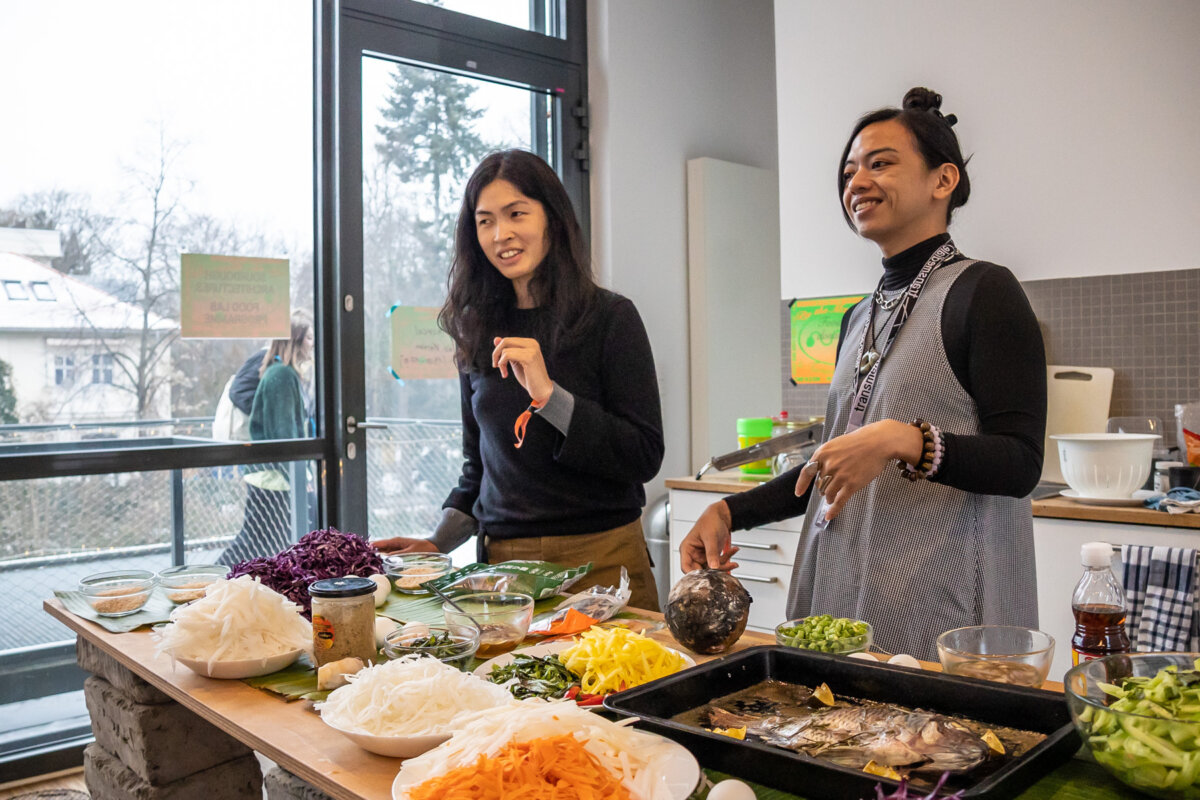 Nathalie Muchamad, Intertropical Nasi Kerabu, Performance Workshop at transmediale 2026
 Nathalie Muchamad, Intertropical Nasi Kerabu, Performance Workshop at transmediale 2026
 Nathalie Muchamad, Intertropical Nasi Kerabu, Performance Workshop at transmediale 2026