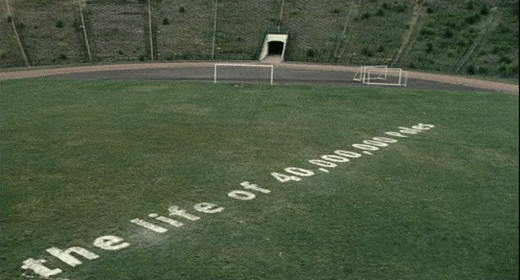
In the middle of the day Slawomir Sierakowski, a young Polish radical leftist, gives a speech in the stadium at Warsaw. During the years of the Polish Republic (1921-1939) this stadium was one of the favorite places for political rallies and street festivals. The speech reflects the aesthetic of nationalist propaganda films, but its content runs counter not only to the style, but to everything on which that style is based. The speaker wrestles with the form, revealing how greatly we are still hampered by nationalistic codes. He speaks before an almost empty stadium, where only a few young people listen to his words. Sierakowski describes the cultural and linguistic consequences of the departure of the Jews after the Second World War to Israel, and calls on the Polish Jews to return to Poland. By citing the style of old nationalistic propaganda films Bartana stresses the similarities between the ideological and visual in this film, in which the speech functions as a form of resistance. Ultimately Bartana is interested in the possibilities (and impossibilities) of the content of the speech and the anti-Semitic and racist questions that a film like this raises.
…
An einem Mittag hält ein junger, radikaler polnischer Linker, Slawomir Sierakowski, eine Rede in einem Stadion in Warschau. Während der Jahre der Polnischen Republik (1921-1939), war dieses Stadion einer der beliebtesten Orte für politische Demonstrationen und Straßenfeste. Die Rede reflektiert die Ästhetik nationalistischer Propagandafilme aber ihr Inhalt widerspricht nicht nur zu deren Stil, sondern allem, worauf dieser Stil überhaupt basiert. Der Sprecher ringt mit der Form, indem er entlarvt, wie sehr wir immer noch durch nationalistische Codes behindert sind. Er spricht vor einem fast leeren Stadium, in dem nur ein paar junge Leute seinen Worten zuhören. Sierakowski beschreibt die kulturellen und linguistischen Konsequenzen der Abreise der Juden nach dem Zweiten Weltkrieg mit dem Ziel Israel und ruft die polnischen Juden auf, nach Polen zurückzukehren. Dadurch, dass er den Stil alter nationalistischer Propagandafilme zitiert, betont Bartana die Ähnlichkeit zwischen Ideologie und Visualität dieses Filmes, in dem die Rede Funktion einer Art des Widerstandes ist. Letztendlich interessiert sich Bartana für die Möglichkeiten (und Unmöglichkeiten) des Inhaltes der Rede und für die antisemitischen und rassistischen Fragen, die ein solcher Film aufwirft.