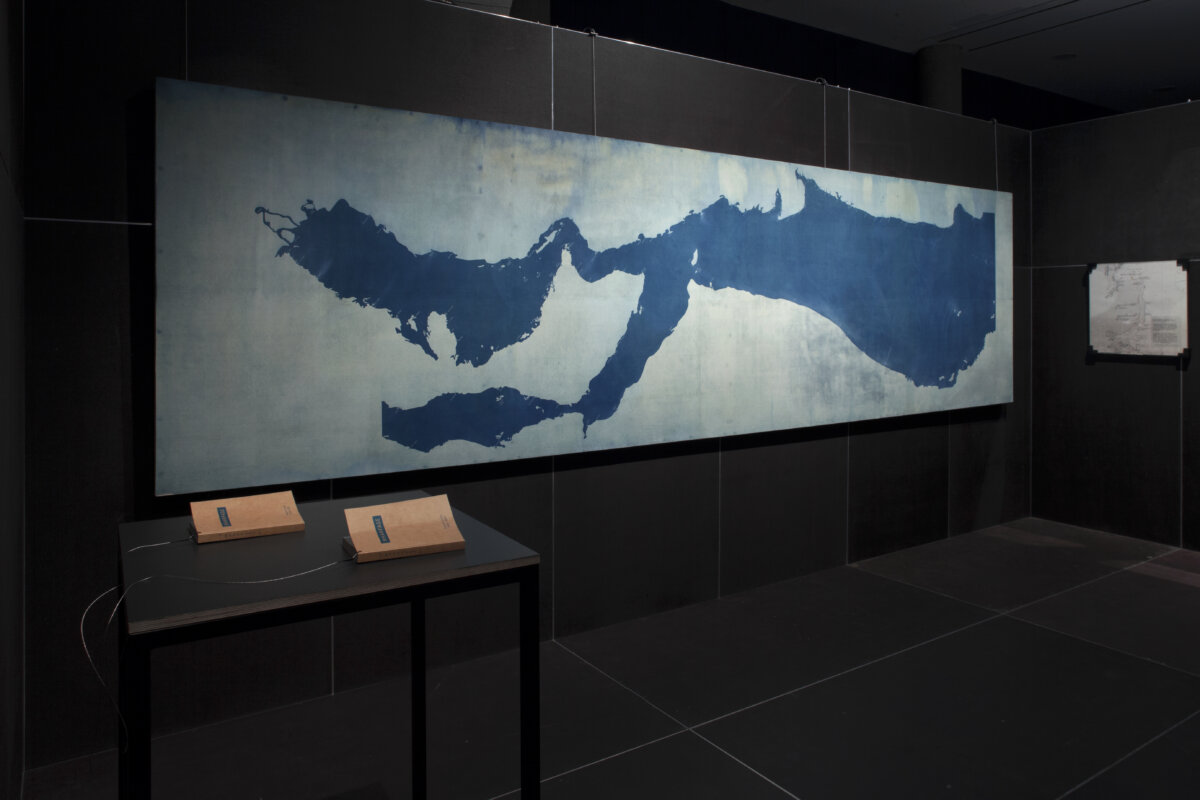
A book, Wharfage, which consists primarily of ship’s manifests and provides us with a set of images: a year‐long calendar of boat names and breakbulk goods going to and from ports in the Somali Region via “piracy,” in the year of what was called the global financial crisis. These boats, giant country crafts made of wood, grow bigger, take shape in “wombs” in the ground, and in the social and symbolic life of estuarine towns in the Gulf of Kutch.
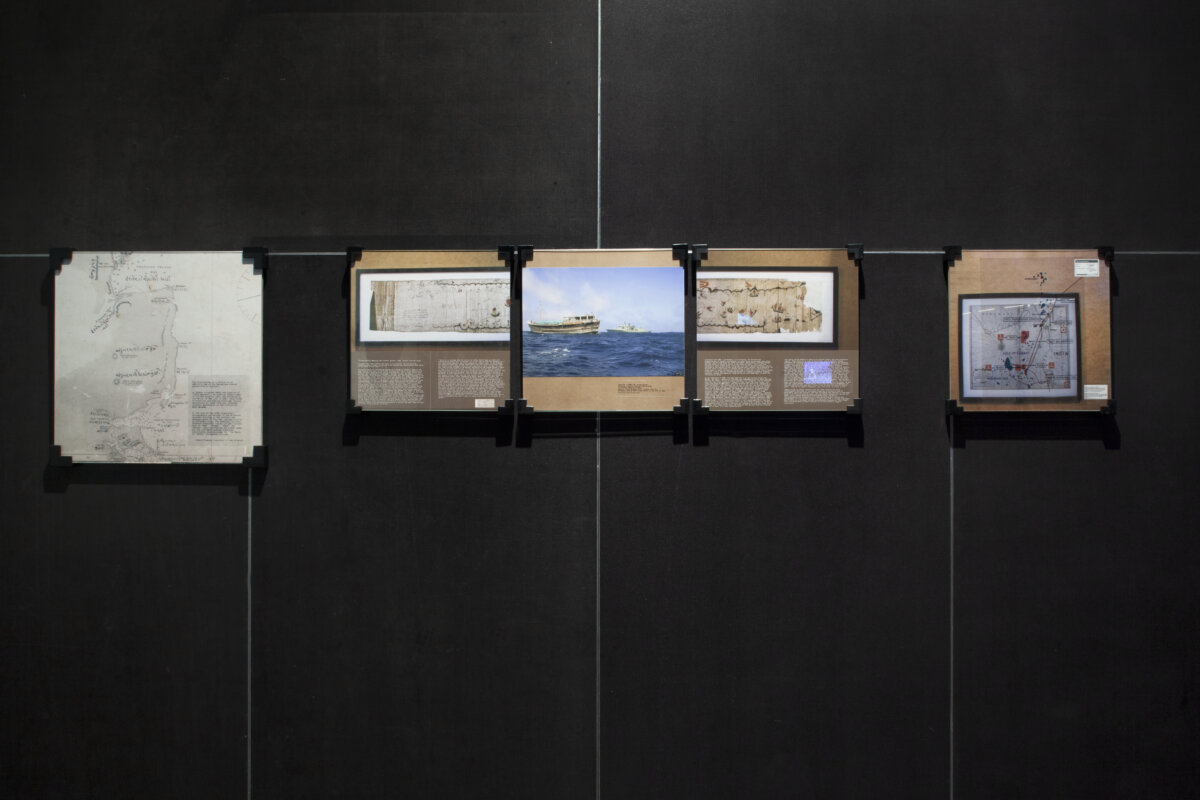
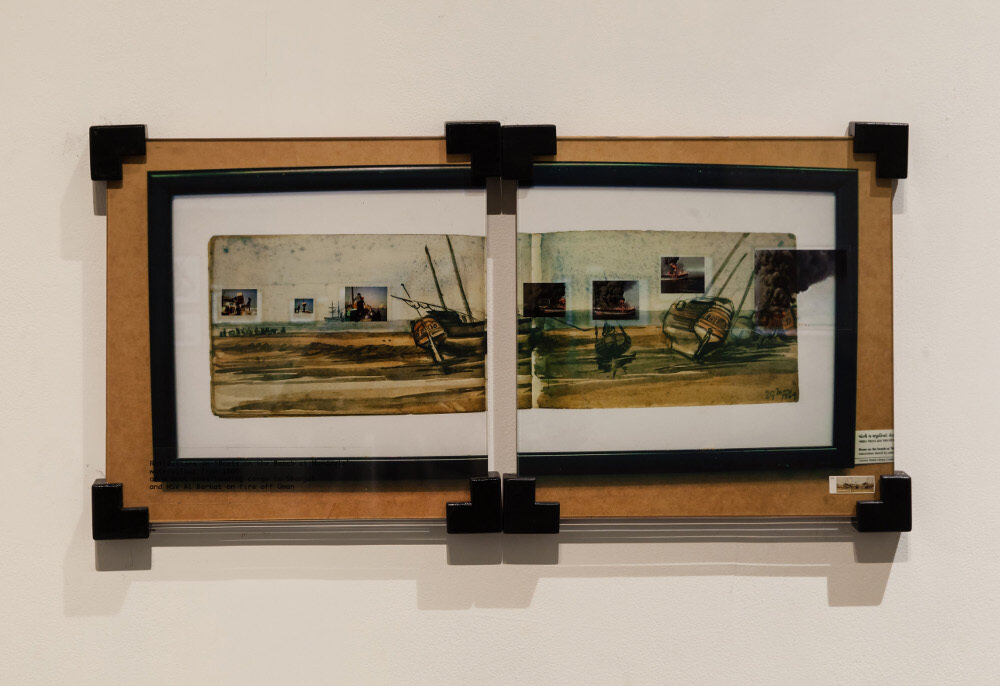
Photographs of colonial maps and paintings that were taken on “digital loan” from British libraries and museums were part of a nostalgic and nationalist exhibition in Mandvi commemorating Gujarat’s maritime history, occluding recent decades of ship building and maritime labor in the town. The Annotated Gujarat and The Sea Exhibition re-photographs these images and reframes the exhibition in terms of this “missing present.”
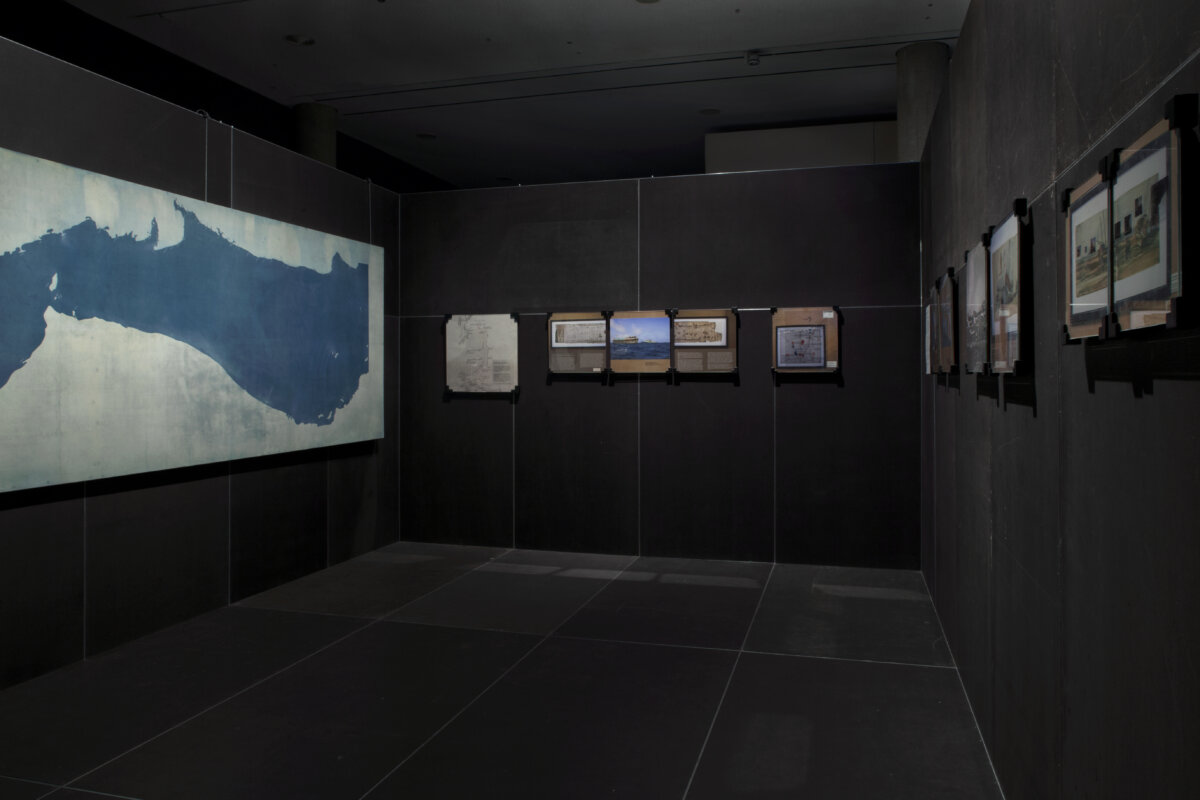
The title piece Country of the Sea, a map made by a group of friends, puts the coasts of India, Pakistan, Iran, East Africa, and the Gulf states in dialog with each other. An image of the sea as its own country, with different types of frontier towns at its edges. These are elements from a multi-year project that formulates a counterpoint to several usual maritime narratives—the imperial “view from the boat,” contemporary metaphors of liquidity and flow, as well as more recent “distressed seas.” It evokes an inhabitation of the seascape by sea-people, across spatial extents that are crossed physically.
…
Ein Buch, Wharfage, das hauptsächlich aus Frachtlisten besteht, zeigt eine Reihe von Bildern: einen einjährigen Kalender aus Bootsnamen und Stückgut, das durch „Piraterie“ in somalische Häfen ein- und ausgefahren wurde, im Jahr der sogenannten globalen Finanzkrise. Diese Schiffe, riesige Gewerke aus Holz, werden noch größer, nehmen in „Mutterschößen“ im Boden Gestalt an sowie im sozialen und symbolischen Leben der Ästuar-Städte im Golf von Kachchh.
„Digital geliehene“ Fotografien von kolonialen Landkarten und Gemälden waren Teil einer nostalgischen und nationalistischen Ausstellung in Mandvi, in welcher der Seefahrtsgeschichte von Gujarat gedacht wurde – die weniger weit zurückliegenden Jahrzehnte des Schiffbaus und der maritimen Arbeit in der Stadt blieben unerwähnt. Für The Annotated Gujarat and The Sea Exhibition wurden diese Bilder erneut fotografiert und die Ausstellung im Sinne dieser „fehlenden Gegenwart“ neu in Szene gesetzt.
Die namensgebende Arbeit Country of the Sea ist eine Landkarte, die von einer Gruppe von Freunden gestaltet wurde. Sie setzt die Küsten von Indien, Pakistan, dem Iran, Ostafrika und den Golfstaaten in Dialog miteinander: Ein Bild des Meers als eigenständiges Land, mit verschiedenen Arten von Grenzstädten an seinen Rändern.
Dies sind die Elemente eines mehrjähriges Projekts, das einen Gegenentwurf zu gängigen Seefahrtsnarrativen darstellt – der imperialen „Perspektive vom Boot“, zeitgenössischen Metaphern von Flüssigkeit und Fluss sowie jüngst der „aufgewühlten See“. Es stellt sich eine Besiedelung des Seeraums durch See-Menschen vor, die sich über Räume erstreckt, die real überquert werden.
Related Events
- 01.02.18.19:30– 21:30Unpacking Country of the Sea: From Gulf to Gulf to Gulf
with CAMP
- Artist Presentation
HKW - Exhibition Hall 1 - 01.02.18.11:30– 13:00Transversal Values: On New Forms of Coalition
with Shaina Anand, Nadia Idle, Lisa Nakamura, Stefan Rusu, Oliver Lerone Schultz, Penny Travlou
- Discussion
HKW – K1