
The 39th edition of transmediale looks at the re·figuration of systems, cosmologies, and technologies through the metaphorical coordinates By the Mango Belt & Tamarind Road. The festival is reimagined as a living recursive carrier net – a hammock of relational technologies in practice that stretch across latitudes, rhythms, and systems.
Understanding Compassing, Metaphoring, and Protocoling as ways to bridge a multiplicity of recipes to the root-code of our systems, the festival asks if your imagination is hungry; what are the currents on our feeds; what’s at the root of our codes.
By the Mango Belt & Tamarind Road lies a space·time for encounter, for trade, and for exchange. A space for communal and collective maneuvering, for navigation across shifting tides and winds. Guided by various Research Netting Groups, which form the undercurrents of the festival, distributed IRL and URL gatherings take place over the preliminary months in collaboration with local hosts – artists, technologists, collectives, and cultural spaces – across locations within the Mango Belt & Tamarind Road. Our Netting Groups cultivate holding·structures of reciprocity designed to outlive the festival itself. Their digital and performative traces will form the containers that hold space and time during the Berlin gathering. From there, these traces will circulate back across interTropical locations, braiding Berlin into a wider exchange.
Along these routes, lateral currents carry seeds, minerals, and stories in polyrhythmic patterns - braiding ecologies, rhythms, and cosmologies that cannot be contained by a single map. Drawing upon these parallel itineraries, transmediale 2026 frames the Mango Belt & Tamarind Road not as a fixed intersection, but as a roundabout to speak alongside: elastic, multiple, centrifugal. A place to return to and drift away.
While hemispherical meshworks and multipolar geopolitics are emerging, supposedly challenging universal systems, they often continue to operate under patriarchal codes and imperialist logics. Even decentralised infrastructures replicate hierarchies, extending dominance, control, and vertical power into new guises.
The imaginative coordinates by the Mango Belt & Tamarind Road call us to examine the underlying structures that sustain the constructs and conducts of our systems - both physical and imaginative: What are ways of netting otherwise? How could we re·wire the root-codes of our systems and condition us differently? What forms of infra·structuring, holding·structuring, and hanging·structuring can emerge when we step outside extractive paradigms?
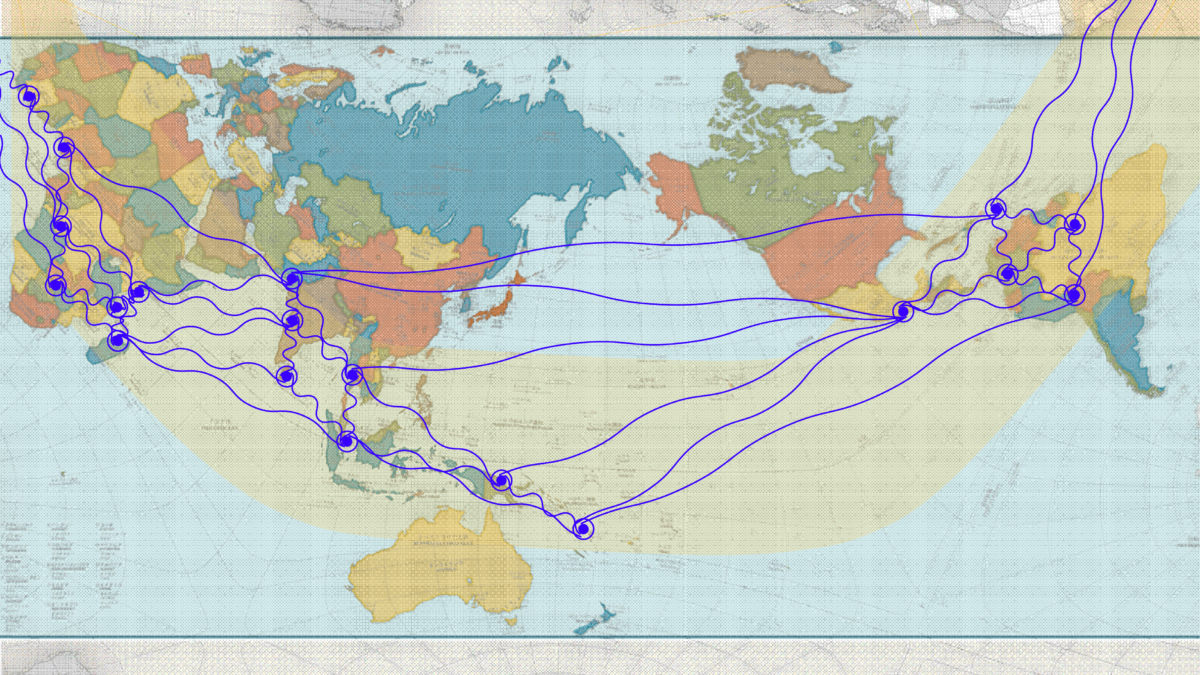
Infrastructuring is not the exclusive domain of corporations and nations. Across the tropics and beyond, there are longstanding ways of holding space, stretching time, and netting together - recipes and architectures of relation that outlive standardisation and universality. To merely diversify ingredients is not enough if we keep following the same models; transmediale 2026 asks how we can instead shake recipes.
At the root of transmediale 2026 is an elastic·structure shaped by compassing, metaphoring, and protocoling.
Compassing is about re·orienting, maneuvering, and pacing our algo·rhythms. Rather than seeking fixed direction or optimisation, compassing attunes us to shifting currents and relational velocities - moving with the tides, not against them. Together with our Local Curriculum Designers (affectionately called LCDs circulating imageries), we gather in Netting Groups to attune the compass - setting directions and rhythms in Pasifika, the Swahili Coast, SEA (South East Asia) and Abya Yala. This curatorial compass is a living compass that might change form and length over time.
Metaphoring is the practice of bypassing inherited logics and re-routing our technological imaginaries through vehicles of transport: stories, metaphors, and carriers that hold knowledge across distances. To metaphor is to re-code by way of imagery and relation, opening portals between systems that rarely speak.
Protocoling refers to translating situated practices into technological protocols. It is about developing pocket infrastructures, holding·structures, and hanging·structures - small yet resilient architectures that enable collective use, reciprocity, and ongoing relation. In Berlin, these protocols take shape as installations, sonic experiments, and multi-specific assemblies, resonating with the Netting Groups’ ongoing processes.
Together, these gestures compose an elastic structure: one that stretches across places and tempos, holds multiplicity without collapse, and makes space for technologies to be re·wired by the rhythms of relation rather than the logics of extraction.
~ Neema Githere and Juan Pablo García Sossa ~

Ben Okri, The Famished Road, 1991
Ursula K. Le Guin, A Rant about “Technology”, 2005
Leslee Goodman, ‘Between Two Worlds: Malidoma Somé on Rites of Passage’, The Sun Magazine, July 2010