
IRL research gatherings centered around different locations across the tropical belt.
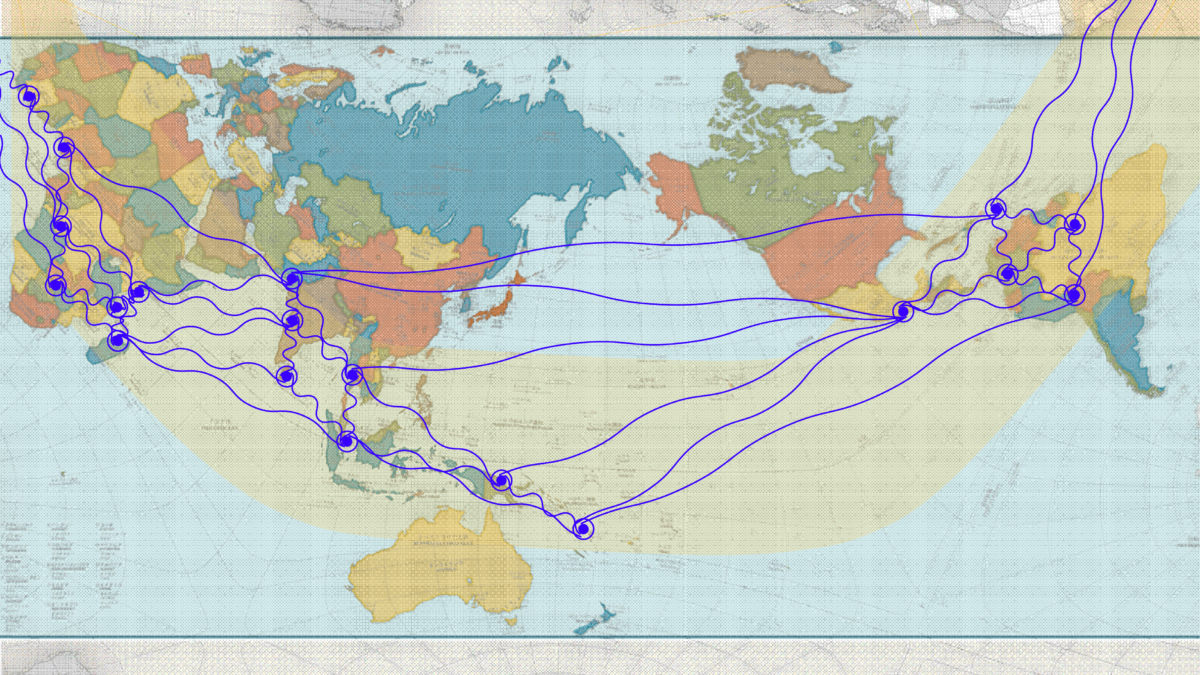
At the heart – and moving through the undercurrents – of the relational, process-based approach to the 2026 festival are the Netting Groups: a series of gatherings co-hosted with regional partners and coordinated by local curriculum designers (LCDs), focusing on lateral exchange across community networks around the imaginative coordinates By the Mango Belt & Tamarind Road.
Attuned to situated endemic knowledges, and the techno-political imaginations that arise from specific climatic, cultural, and infrastructural conditions, each Netting Group brings together artists and technologists from diverse disciplines. Through co-designed activations and workshops, elastic mobile infrastructures, and hyperlocal techno-rituals, the gatherings braid pluriversal perspectives on computing, archiving, storytelling, and worlding – foregrounding situated forms of life and technologies that cultivate ways of living beyond extraction, acceleration, and global homogenization.
The Netting Groups nurture holding·structures of reciprocity – ongoing processes intended to extend beyond the festival itself. As they unfold, each group generates digital and performative “traces”: materials, gestures, recordings, and reflections that will shape the festival in Berlin.
Together, the Netting Groups will set the tone, rhythm, and orientation of the festival days.
Often mythologized on account of its endemic potency, Papua New Guinea embodies the encryption definitive of the relational ecosystems across the Mango Belt and Tamarind Road. This group is anchored by a foundational velocity of moving at the speed of trust–divesting from programmed impulses towards control and predictive logic(s). Informed by the region’s oceanic contracts of eco-relational adaptivity, responsiveness, and reciprocity, this gathering invites the Netting Groups’ participants to weave the foundation for transmediale’s tropical turns and recursive metaphors through organic protocols.
The participants of the Pasifika Netting Group were film producer and festival director of the Matatu Film Lab Patience Katsushabe , cyber-documentarian Maahleek, sound artist KMRU , sonic-papaya-researcher Merv Espina , with Local Curriculum Designer (LCD) Lynda Irai, as well as transmediale 2026 curators Neema Githere and Juan Pablo García Sossa, working alongside an expansive network of community practitioners.
The gathering Pasifika was realised in collaboration with the Pan-African Solidarity School (PASS), with support from the Mellon Foundation.

community repair, sachet time cultures and shadow protocols
The participants of the SEA Netting Group were the local curriculum designer (LCD) Merv Espina , producer and on-site coordinator Ping , academic and visual artist Gladys Kalichini , multi-media artist Gabriella Torres-Ferrer , artist and filmmaker Miguel Buenrostro , artist and theorist Isola Tong , visual artist Hoo Fan Chon , artist and curator Lee Tzu Tung , collective DASDNN, as well as transmediale 2026 curators Neema Githere and Juan Pablo García Sossa.
The gathering in Phuket received support from the Goethe-Institut Malaysia, the Goethe-Institut Thailand, and the Thailand Biennale Phuket. Outcomes from the gathering informed the project Instant Kalpa(s), which was presented within the framework of the biennale.
The Swahili Coast Knot unfolds as a week-long intertropical gathering across Nairobi, Lamu, and Watamu. Following the currents of land, rail, air, and water, the journey becomes a living net - metaphoring infrastructures of travel into practices of transmission and relation. The knot brings together practitioners - spacialists designing the temporary architectures of the 2026 festival - LAN·SCAPES, and protocols along one of the oldest and most interconnected cultural corridors in the planet.
Participants of the Swahili Coast Netting Group include film producer and festival director of the Matatu Film Lab Patience Katsushabe , spatial artist and futurist Kidus Hailesilassie , interdisciplinary artists Catherine Lie and Rochelle Webster Nembhard , digital artist Jepchumba , musician Maya Wegerif , designer and researcher Jess Rowley , artist and curator Tsige Tafesse , sonic-video artist Yoon Ra , cultural worker and historian Wairimũ Nduba , as well as transmediale 2026 curators Neema Githere and Juan Pablo García Sossa.
The gathering on the Swahili Coast was realised in collaboration with the Pan-African Solidarity School (PASS), with support from the Mellon Foundation.
-
Catherine Anabella Lie
-
DASDNN
-
Gabriella Torres-Ferrer
-
Gladys Kalichini
-
Hoo Fan Chon
-
Isola Tong
-
Jess Rowley
-
Jepchumba
-
Kidus Hailesilassie
-
KMRU
-
Lee Tzu Tung (李紫 彤)
-
Lynda Irai
-
Maya Wegerif
-
Merv Espina
-
Miguel Buenrostro
-
Patience Katushabe
-
Ping
-
Rochelle Webster-Nembhard
-
Tsige Tafesse
-
Yoon Ra
-
Wairimũ Nduba