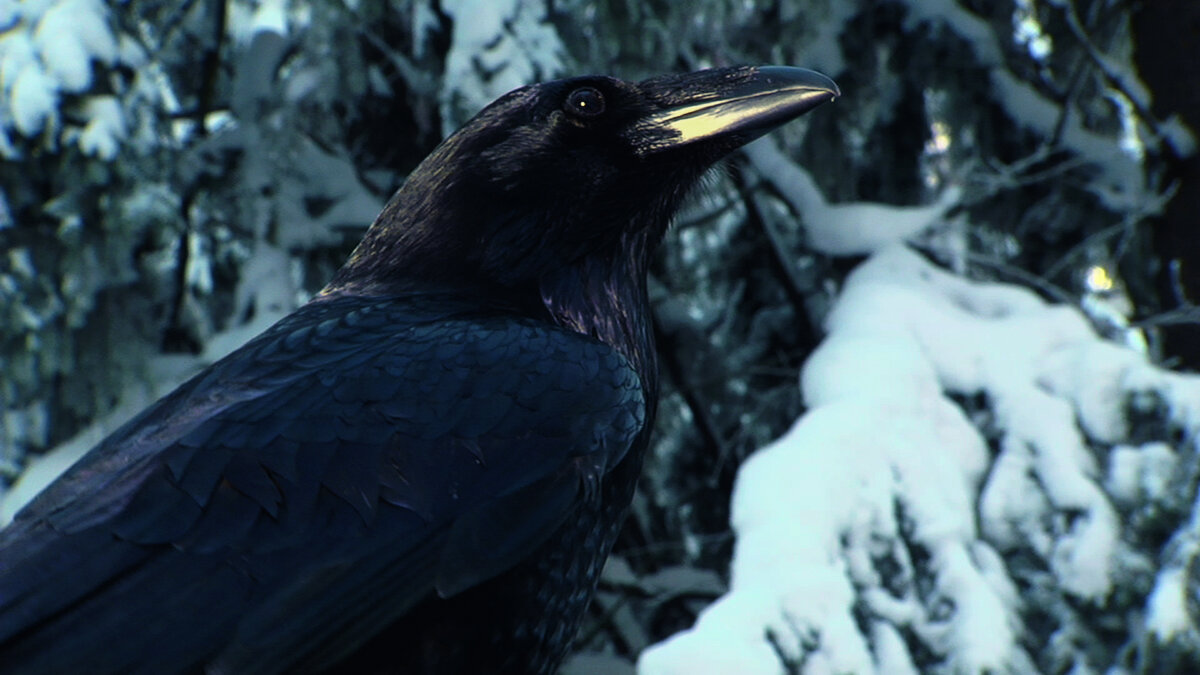
The Annunciation is a film in which one of the central motifs of Christian iconography is constructed and re-enacted through moving image. It is based on the narrative in the Gospel of Luke (1:26-38) and on paintings of the Annunciation in which artists have, in various periods, depicted their visions of the gospel’s events. In this Annunciation the events are set in the present. The footage was shot mainly during the frosty winter season of 2010 in the snowy Aulanko nature reserve in southern Finland and on a set depicting an artist’s studio and the scene of the Annunciation. All human actors except for two are non-professionals. Most of them are clients of the Helsinki Deaconess Institute’s women’s support services. The animal actors are a trained raven, two ordinary donkeys and a group of carrier pigeons from a bird farm. Although based on an existing script, the events, roles and dialogue were adapted during the filming process to the actors’ individual presence. The underlying viewpoint in the Annunciation is Jacob von Uexküll’s idea that the different worlds of living beings all exist simultaneously. The idea is used as the approach for an exploration of the nature of miracles and the possibilities of perception and knowledge. In the work, the actors reconstruct the sacred, and in the process redefine the human through the divine and the animal.
…
Im Film The Annunciation wird eines der zentralen Motive der christlichen Bilddeutung durch bewegte Bilder konturiert und nachgestellt. Er basiert auf der Erzählung des Evangeliums nach Lukas (1:26-38) und auf Gemälden der Verkündigung, in denen Künstler zu verschiedenen Zeitpunkten ihre Vorstellung der Ereignisse ausgedrückt haben. In dieser Verkündigung werden sie in die Gegenwart übertragen. Das Material wurde hauptsächlich im verschneiten Naturreservat Aulanko in Südfinnland während des frostigen Winters 2010 aufgenommen. Das Set zeigt das Studio eines Künstlers und die Verkündigungsszene. Alle Personen bis auf zwei sind Laienschauspieler. Die meisten von ihnen sind Klienten des Helsinki Deaconess Instituts für die Beratung und Unterstützung von Frauen. Die tierischen Schauspieler sind ein dressierter Rabe, zwei gewöhnliche Esel und einige Brieftauben aus einer Vogelzucht. Obwohl es ein Drehbuch gab, wurden die Ereignisse, Rollen und Dialoge während des Filmens an die individuelle Situation des Schauspielers angepasst. Der Film unterliegt der Ansicht Jacob von Uexkülls, dass die verschiedenen Welten von Lebewesen alle gleichzeitig existieren. Diese Idee wird als Ausgangspunkt für die Untersuchung der Natur von Wundern genommen und für die Möglichkeiten der Wahrnehmung und des Wissens. In diesem Werk rekonstruieren die Schauspieler das Heilige – und während dieses Prozesses definieren sie auch das Menschliche neu, durch das Göttliche und das Animalische.