Measuring living systems goes hand in hand with organisms made to measure, as stated by Sigfried Giedion in 1948, as soon as “mechanization takes command.” Since Marey’s and Gilbreth’s measurements of movement, standardization, interchangeability and the hierarchization of parts have increasingly transformed creatures into commodities. And while the biological sciences today shift their focus from analysis to synthesis, the resulting language of engineering focuses less on living beings than on ‘components’ or ‘circuits.’
Departing from Revital Cohen and Tuur Van Balen’s performative installations, provocative objects and aestheticized documentary films shown in the exhibition assemble | standard | minimal at the project space of the Schering Foundation and at transmediale, the artists, the curator Jens Hauser, philosopher of science Tobias Cheung and media theoretician Paul Feigelfeld discuss the impacts of standardization and engineering logics applied to living systems in the cultural contexts of the West and the East.
But hasn’t the very notion of organization itself always played a role in the concept of what accounts for an organism? What are the historical drives behind today’s biobricks, mackerels engineered to produce tuna, or egg freezing for female employees in Silicon Valley? And how do artists deal with the posture of complicity when manipulating living systems themselves?
For Revital Cohen and Tuur Van Balen’s new work Sterile, albino goldfish without any reproductive organs are being specifically designed, paralleled by a machine capable of extracting sperm and eggs to reproduce sterile fish infinitively – but not (yet) switched on. In 75 Watt and Pigeon d’Or, human and animal organisms are being used in highly controlled (dys)functional processes.
Die Vermessung lebendiger Systeme geht Hand in Hand mit nach Maß gemachten Organismen, sobald die “Herrschaft der Mechanisierung” die Überhand gewinnt, wie Sigfried Giedion 1948 schrieb. Seit Mareys and Gilbreths Bewegungsstudien sind Kreaturen durch Standardisierung, Austauschbarkeit und die Hierarchisierung ihrer Bestandteile zunehmend in Rohstoffe verwandelt worden. Und so wie in der Biologie heute zunehmend nicht mehr nur analysiert sondern synthetisiert wird, so wird im entsprechenden Ingenieursvokabular weniger von Lebewesen als von ‘Komponenten’ und ‘Schaltkreisen’ gesprochen.
Ausgehend von Revital Cohens und Tuur Van Balens performativen Installationen, provokativen Objekten und ästhetisierten Dokumentarfilmen, die in der Ausstellung assemble | standard | minimal im Projektraum der Schering Stiftung sowie auf der transmediale gezeigt werden, diskutieren die Künstler, der Kurator Jens Hauser, der Wissenschaftsphilosoph Tobias Cheung und der Medientheoretiker Paul Feigelfeld über Standardisierung und auf Lebenssysteme angewandte Ingenieurslogik in westlichen und östlichen Kulturkreisen.
Aber hat nicht der Begriff der Organisation nicht immer schon eine Schlüsselrolle gespielt, wenn es darum ging, das Wesentliche eines Organismus zu definieren? Welcher historische Trieb verbirgt sich hinter heutigen Biobricks, zur Thunfischproduktion modifizierten Makrelen und eingefroreren Einzellen weiblicher Angestellter im Silicon Valley? Und wie gehen Künstler mit der Attitüde ihrer Komplizenschaft um, wenn sie selber lebendige Systeme manipulieren?
Revital Cohens und Tuur Van Balens neue Arbeit Sterile zeigt designte Albino-Goldfische ohne Fortpflanzungsorgane neben einer Maschine im Stand-by-Modus, die aus zuvor extrahierten Eizellen und Sperma sterile Fische beliebig reproduzieren kann. In ihren Arbeiten 75 Watt und Pigeon d’Or werden menschliche und tierische Organismen in den Dienst hochkontrollierter (dys)funktionaler Prozesse gestellt.
Related Media
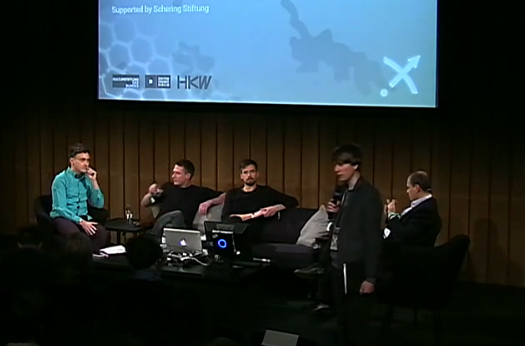 Introduction by Kristoffer Gansing and Jens Hauser – Made to Measure
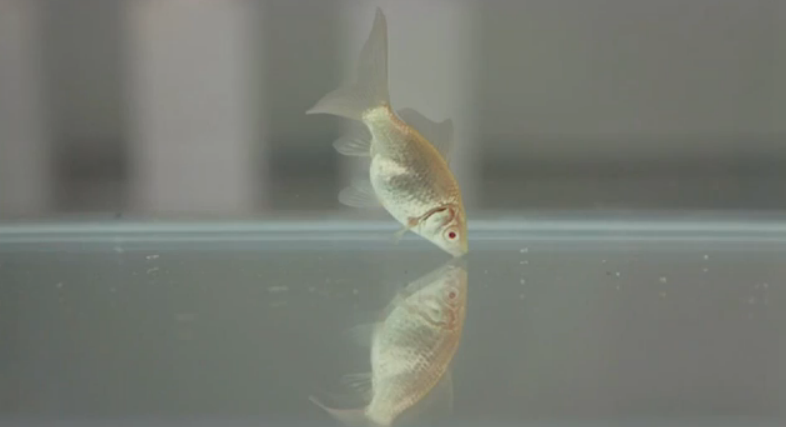 Presentation by Tuur van Balen – Made to Measure
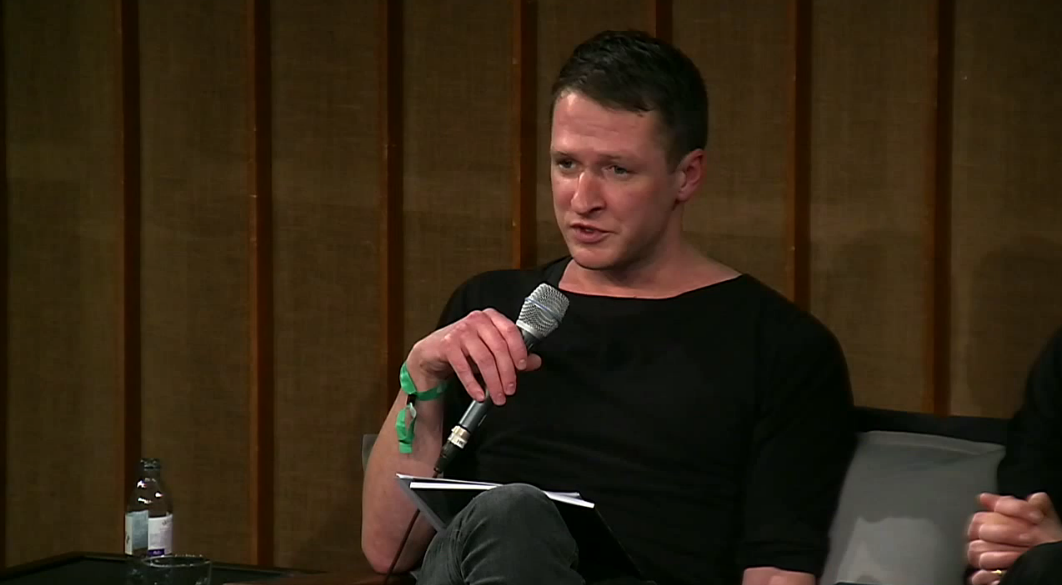 Presentation by Paul Feigelfeld – Made to Measure
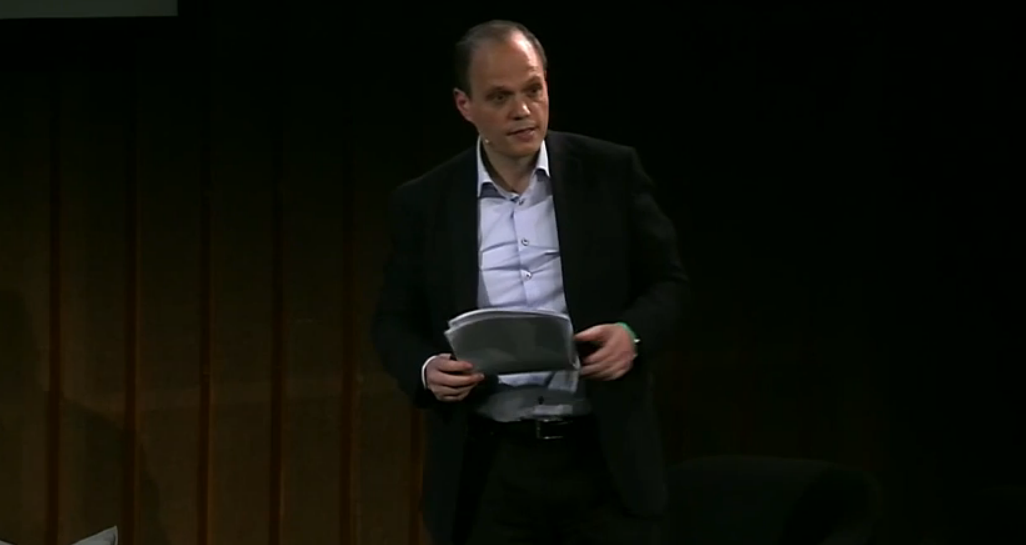 Presentation by Tobias Cheung – Made to Measure
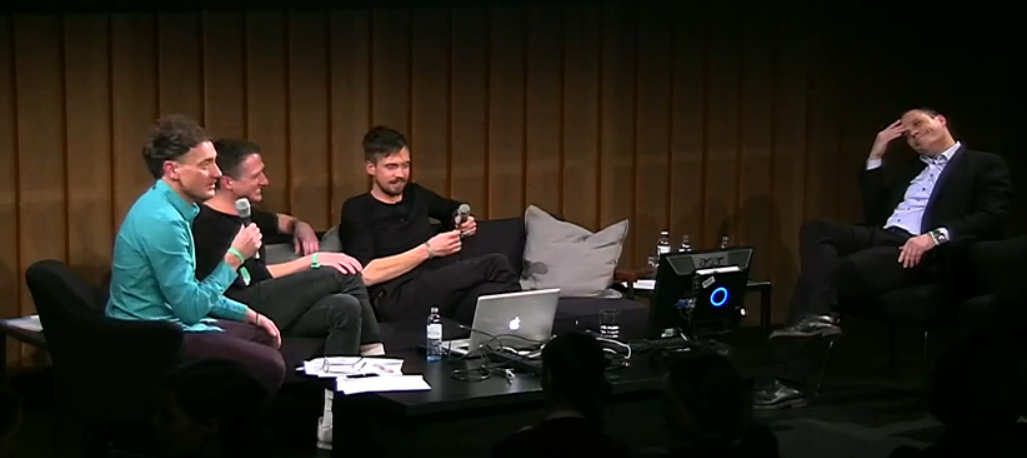 Discussion – Made to Measure
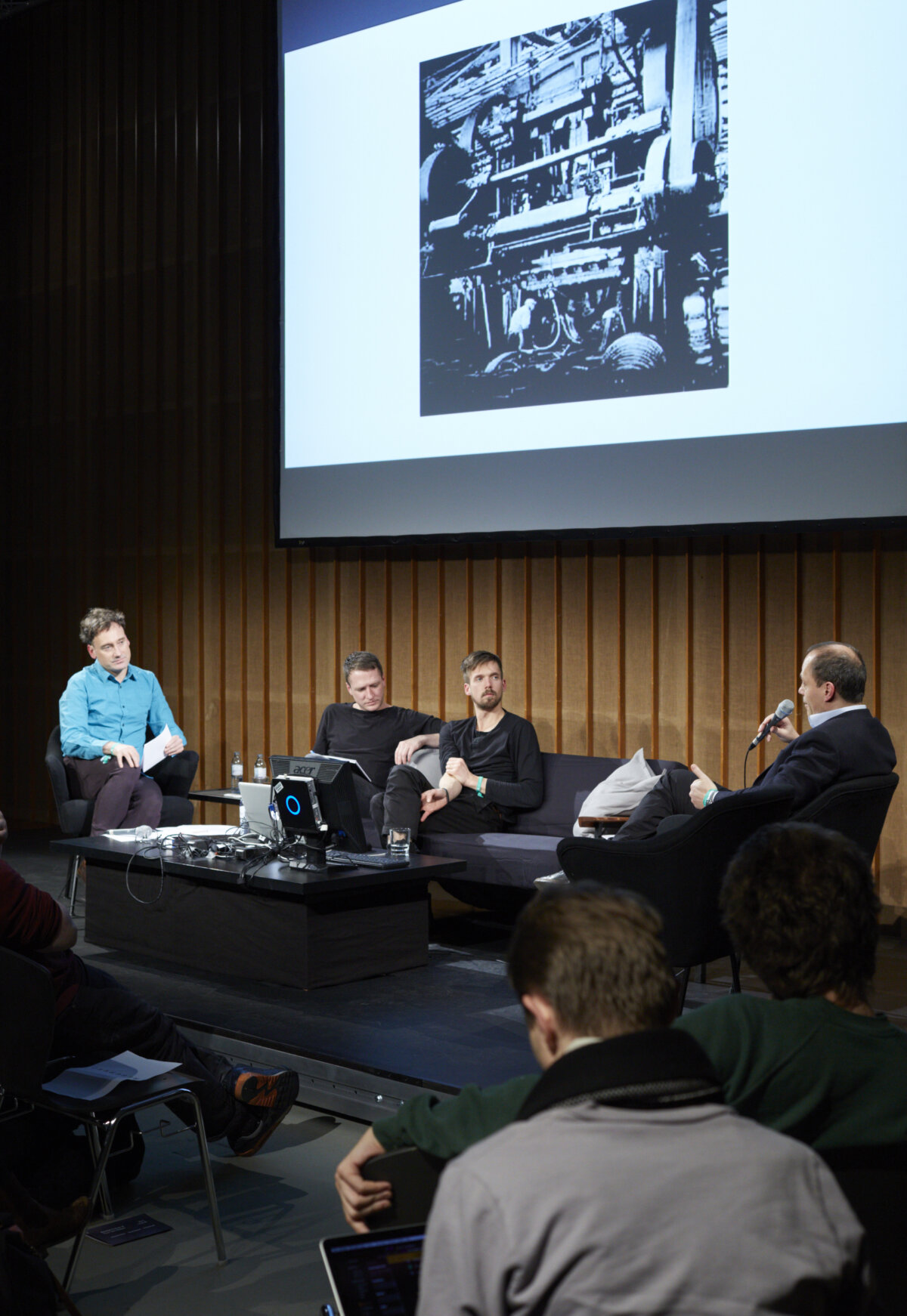 Jens Hauser, Paul Feigelfeld, Tuur Van Balen and Tobias Cheung (left to right) at "Made to Measure"