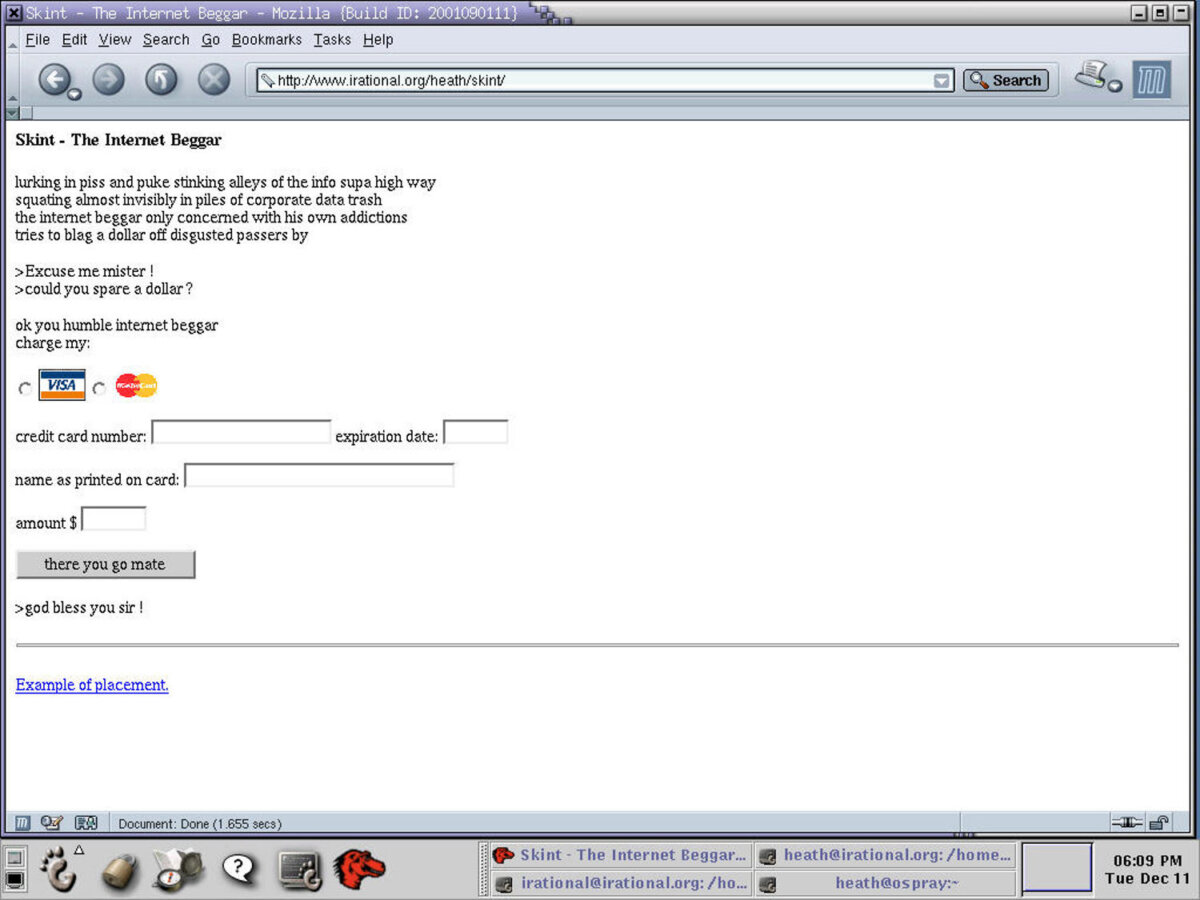
Who at the time when the first waves of the dot.com hype hit the shores of Internet culture would have imagined that this new economy could reproduce a figure of financial scarcity known from the physical world? An Internet beggar!? Was this global network not supposed to overcome such old-fashioned social problems and release us all into an endlessly rich virtuality? Maybe, but the situation is also more intricate than a matter of simple reproduction. The “internet beggar” in this piece by Heath Bunting is smart. He understands the Internet and takes advantage of it, just like the pioneers of the dot.com economy. Squatting the information superhighway, he supposedly earned around 25,000 Euros in the first year of his activity. Moreover, he has survived the bust of the dot.com bubble and continues to work. “Excuse me mister! Could you spare a dollar?”
Image: Heath Bunting
…
Wer hätte zu der Zeit, als die ersten Wellen des dot.com-Hypes an die Ufer der Internetkultur rollten, geglaubt, dass dieser neue Wirtschaftszweig eine Figur finanziellen Mangels übernehmen würde, die man aus der physischen Welt nur zu gut kennt? Ein Internet-Bettler?! Sollte dieses globale Netzwerk solche altmodischen gesellschaftlichen Probleme nicht überwinden und uns alle in eine unendlich reiche, freie Virtualität katapultieren? Möglich, doch ist die Situation etwas komplexer als ein Fall bloßer Reproduktion. Der „Internet-Bettler“ aus der Arbeit von Heath Bunting ist schlau. Er versteht das Internet und nutzt es zu seinem Vorteil, ganz genauso wie die Pioniere der dot.com-Wirtschaft. Als Besetzer der Datenautobahn verdiente er im ersten Jahr seiner Aktivitäten angeblich um die 25.000 Euro. Außerdem hat er es geschafft, das Platzen der dot. com-Blase zu überleben und ist nach wie vor beschäftigt. „Entschuldigen Sie, haben Sie einen Dollar für mich?“
Image: Heath Bunting