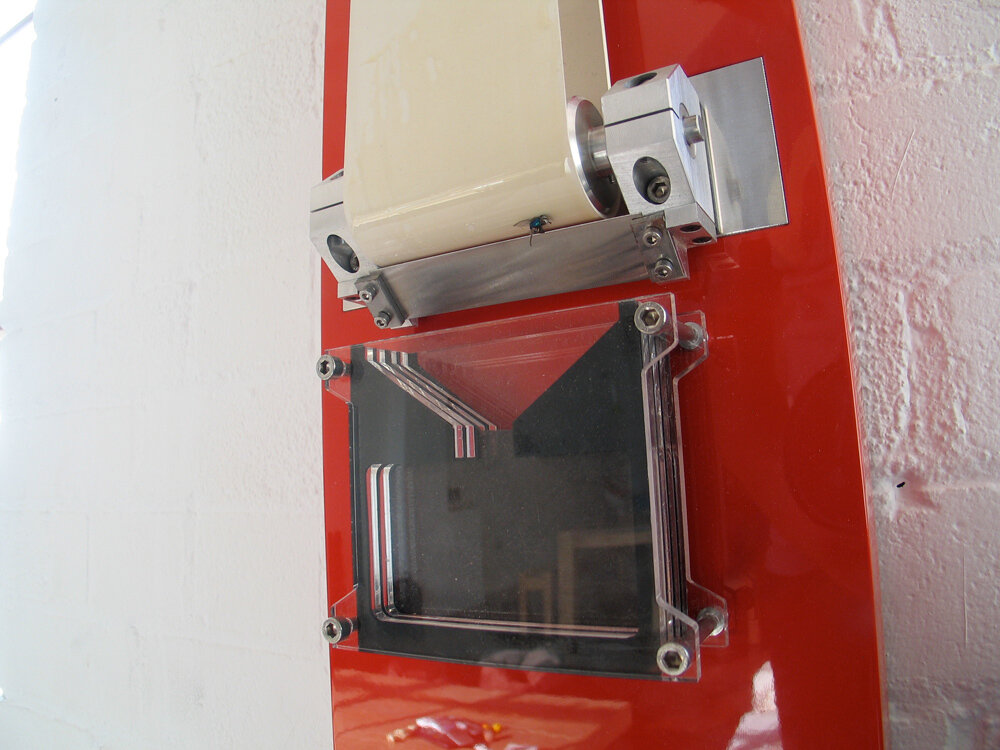
With the Carnivorous Domestic Entertainment Robots James Auger, Jimmy Loizeau and Alex Zivanovic propose a new type of domestic robot that creates a new category of object that exists somewhere between a product and predatory pet. The artists contend that if robots are ever to be welcomed into people's homes, they'll need to fit in with the rest of the furniture, and earn their keep. Their prototypes trap and digest pests like flies and mice to gain energy. Traditional fly-catchers, using sticky-tape and UV light have no method to manage the waste produced by the carcass of the pest. The Carnivorous Domestic Entertainment Robots prototypes power themselves with special fuel cells that are able to produce electricity by processing the bodies of flies, and in one case, mice.
These unsettling apparati, including a sticky conveyor belt clock and moth-attracting death lamp are a bizarre hybrids between machine and living organism. They are an example of the emerging field of 'critical design' or 'speculative design', where designers create prototypes to stimulate debate, discussion, and in some cases controversy.
transmediale.10 are showing a series of Carnivorous Domestic Entertainment Robots at the House of World Cultures, including the Flypaper robotic clock, the Coffee table robot, and the Lampshade robot.
…
Die Künstler sind der Überzeugung, dass sich Roboter, sollten sie jemals wirklich in unsere Häuser gelassen werden, nicht nur konzeptuell mit unseren Möbeln vertragen müssen, sondern v. a. nützlich sein müssen. Ihre Prototypen fangen und verdauen deshalb zum eigenen Energiegewinn Fliegen und kleine Mäuse. Herkömmliche Fliegernfänger mit Klebeband oder UV Licht sind somit endlich überholt – das lästige Aufräumen und Wegputzen von Überresten bleibt uns in Zukunft erspart. Diese verstörenden Geräte, darunter eine klebrige Fließbanduhr und eine Motten anziehende Todeslampe, sind ausgefallene Hybride zwischen Maschine und Lebewesen und packende Beispiele von 'kritischem' oder 'spekulativem' Design, in dessen Rahmen Designer bizarre Prototypen entwerfen um, wenn schon keine Kontroversen, so doch immerhin die Diskussion anzuregen.
transmediale.10 zeigen einige der Carnivorous Domestic Entertainment Robots im Haus der Kulturen der Welt. Sie tragen vielsagende Namen wie: Flypaper Robotic Clock, Coffee Table Robot oder Lampshade Robot.
Coffee Table Robot: Dieses Kaffeetischchen funktioniert gleichzeitig als Mausefalle. Krümel liegen als Köder auf der Tischplatte aus. Die Mäuse werden angelockt und klettern durch ein Loch in das Tischbein ganz rechts. Sobald eine Maus sich auf der Falltür in der Mitte befinden, öffnet sich sich via Sensoren und das Tierchen fällt in eine mikrobische Treibstoffzelle. Die verdaute Maus produziert genug Energie, um die Falltür, den Sensor und eine vorn am Tisch angebrachte LED Anzeige zu betreiben.
> http://www.materialbeliefs.com/prototypes/cder.php
> http://www.auger-loizeau.com/