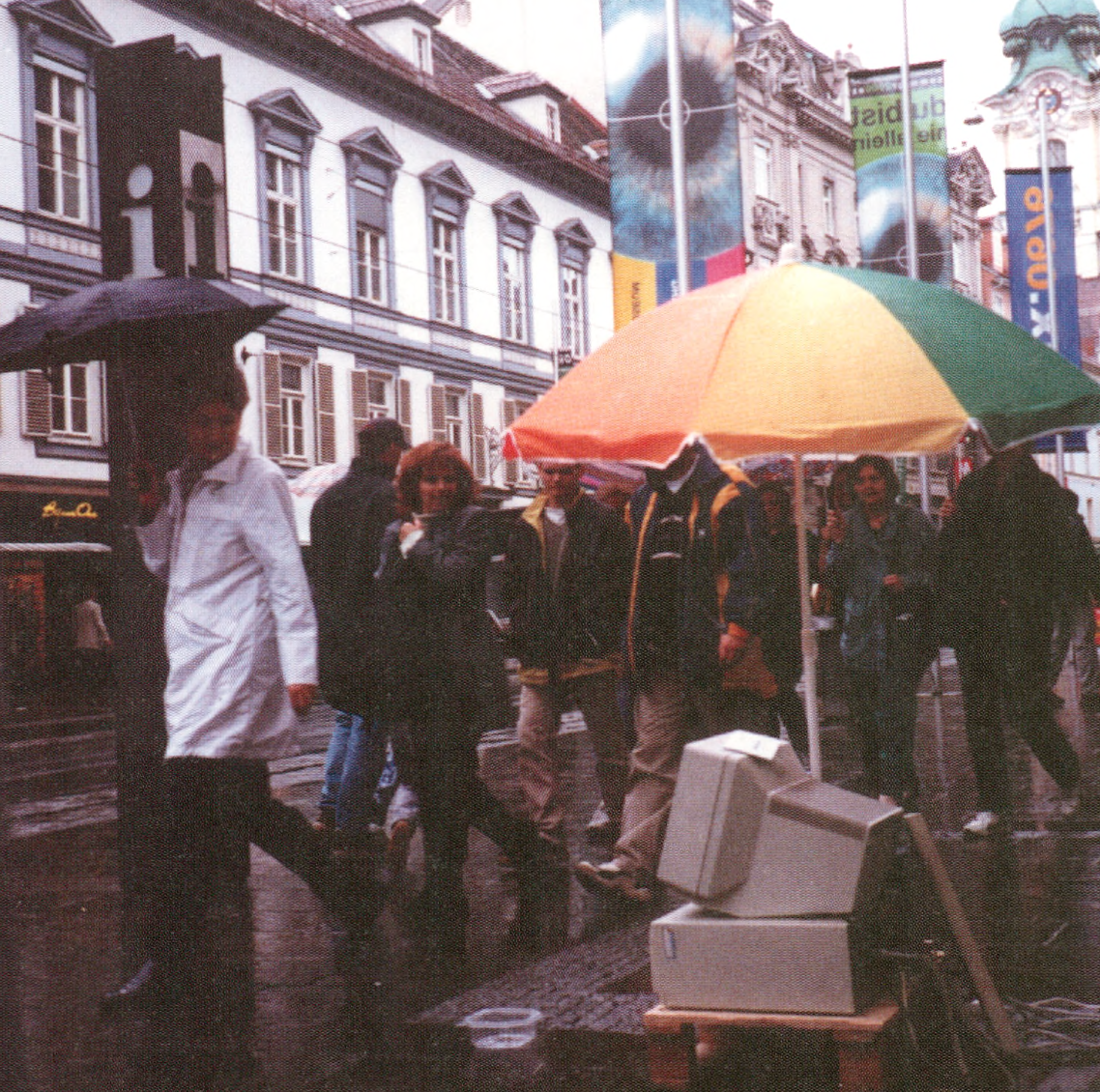
The rededication of an old question: can the degree of civilisation of asociety be judged by the way this society deals with old computers? Now, assuming this to be so, Western European societies do not score very heavily. In these parts, old, but still functioning computers are simply scrapped, made redundant and without remorse left to corrosion and an existence without a task and no perspective. That this doesn’t need to be so, and that even computers with limited storage capacity can still take on a function in society, is illustrated by Alexei Shulgin’s outdated 386, now serving as a street musician. Performing well-known songs such as “House of the Rising Sun” or “California Dreaming”with all the charme available to a text-to-speech- programm, and asking for only small donations, it waits for the generous passer-by. The ironic comment delivered by Shulgin and his singing computer is well within the context of the performances by the 386 DX rockband, with which he “toured” Europe in 1998 and performed on nearly 60 occasions. This one-man-one-computer-show was based on a similar idea as his current installation: Shulgin presented himself as a performer carrying a keyboard, and by simply hitting a key elicited the text-to-speech singing, accompanied by very simple music and a few Seventies-style visual effects. It’s a familiar story: the Russian musician, performing on streetcorners and at parties, making more money abroad than with a steady engagement at home. And maybe it’s also true that a society’s degree of civilisation may be judged by the self-ironic attitude of its artists
…
In Umwidmung einer alten Frage: Kann man den Zivilisationsgrad einer Gesellschaft daran ablesen, wie sie mit alten Computern umgeht? Vorausgesetzt dies wäre tatsächlich so,würde die west-europäische Gesellschaft nicht besonders gut abschneiden. Hierzulande häufen sich die Halden mit noch funktionstüchtigen Computern, die wegrationalisiert wurden und nun ganz ohne Aufgabe und Perspektive auf die Korrosion warten. Dass dem nicht so sein muss und auch Rechner mit geringer Speicherkapazität noch eine gesellschaftliche Funktion erfüllen können, zeigt Alexei Shulgin mit einem ausrangierten 386er, der nun als Straßenmusikant Zuhörer in seinen Bann zu ziehen versucht. Bekannte Songs wie „House of the Rising Sun“ oder „California Dreaming“mit dem Charme eines Text-to-Speech- Programmes vortragend, und um ein wenig finanzielle Unter stützung bittend, wartet er auf die milde Gabe der Passanten. Die ironische Arbeit, die Shulgin mit seinem singenden Computer abliefert, liegt ganz auf der Linie der Performances der 386 DX Rockband, mit der er von 1998 an vor allem in Europa erfolgreich „getourt“ und nahezu 60 mal aufgetreten ist. Diese One-Man-One-Computer-Show basierte auf einem ähnlichen Konzept wie die jetzige Installation: Shulgin trat als Performer auf, mit einer Tastatur behängen, auf der er letztendlich nur durch Tastendruck den Text-to-Speech-Gesang samt einfachster Musik und einige der 70er Jahre-Ästhetik verbundenen Visuals auslöste. .Ähnlichkeiten nicht ausgeschlossen: Der russische Musiker, der fern der Heimat mit seiner Party- oder Straßen-Performance mehr verdient als zuhause mit einem festen Engagement. Und ist es nicht vielmehr so, dass man den Zivilisationsgrad einer Gesellschaft an der Selbstironie ihrer Künstler erkennt...